Best AI Study Note Apps for Medical Students 2026
Medical school drowns you in information — anatomy lectures, pathophysiology PDFs, clinical protocols, and endless rounds of studying. AI-powered note apps are changing how med students actually survive.
The volume of material in medical school is staggering. A single anatomy course might cover more content than your entire undergraduate degree. Traditional note-taking methods — even digital ones — struggle to keep up. You need tools that don't just capture information but help you actually learn it.
That's where AI-powered study apps come in. These aren't just note-taking tools — they're study systems that transcribe lectures, generate flashcards, quiz you on material, and even explain complex concepts when you're stuck at 2 AM. Here's our breakdown of the best options for medical students in 2026.
The Med Student Study Problem
Medical students face unique challenges that general productivity apps don't address:
- Dense material — You can't summarize anatomy into bullet points. You need comprehensive understanding.
- Long lectures — 2-3 hour lectures are common. Taking notes while listening is nearly impossible.
- Active recall requirement — You don't just need to remember — you need to apply knowledge clinically.
- Multi-format content — Lectures, textbooks, slides, clinical videos — information comes from everywhere.
"For quick summaries and evidence synthesis, Consensus AI is a popular choice, especially for research-heavy work. However, managing multiple tools can get unwieldy."— Reddit user in r/medschool
The key insight from medical students: you need fewer, better tools — not a fragmented workflow spread across five apps.
What AI Study Apps Actually Do
Modern AI study apps go far beyond basic note-taking:
- Lecture transcription — Record and transcribe entire lectures automatically
- Smart summarization — AI identifies key concepts from walls of text
- Auto-flashcards — Generate flashcards from your notes without manual creation
- Practice quizzes — Test comprehension with auto-generated questions
- AI tutoring — Ask questions about your material and get explanations
The best tools combine multiple features so you're not constantly switching between apps.
Best AI Study Note Apps for Medical Students
1. ChatGPT / Claude
Many med students use general AI chatbots to explain concepts, break down complex topics, and assist with note organization. They're powerful but have limitations.
- ✅ Excellent at explaining complex concepts
- ✅ Can help organize and summarize material
- ❌ No persistent note storage
- ❌ No lecture recording or transcription
- ❌ Doesn't track your progress or create study sets
- ❌ Requires manual input each time
Good for quick questions, but not a complete study system.
2. Notion AI
Notion added AI features to its popular workspace app. It's powerful for organization but wasn't built specifically for studying.
- ✅ Excellent organization and linking
- ✅ AI summarization of notes
- ❌ No lecture recording
- ❌ No flashcard or quiz generation
- ❌ Steeper learning curve
- ❌ More suited for project management than active studying
3. Otter.ai
Otter excels at transcription but stops there. It's a recorder, not a study tool.
- ✅ Accurate transcription
- ✅ Good for capturing lectures
- ❌ No flashcard generation
- ❌ No quiz features
- ❌ No AI tutor
- ❌ Expensive ($16.99/mo for Pro)
4. MelonNote — Complete AI Study Companion
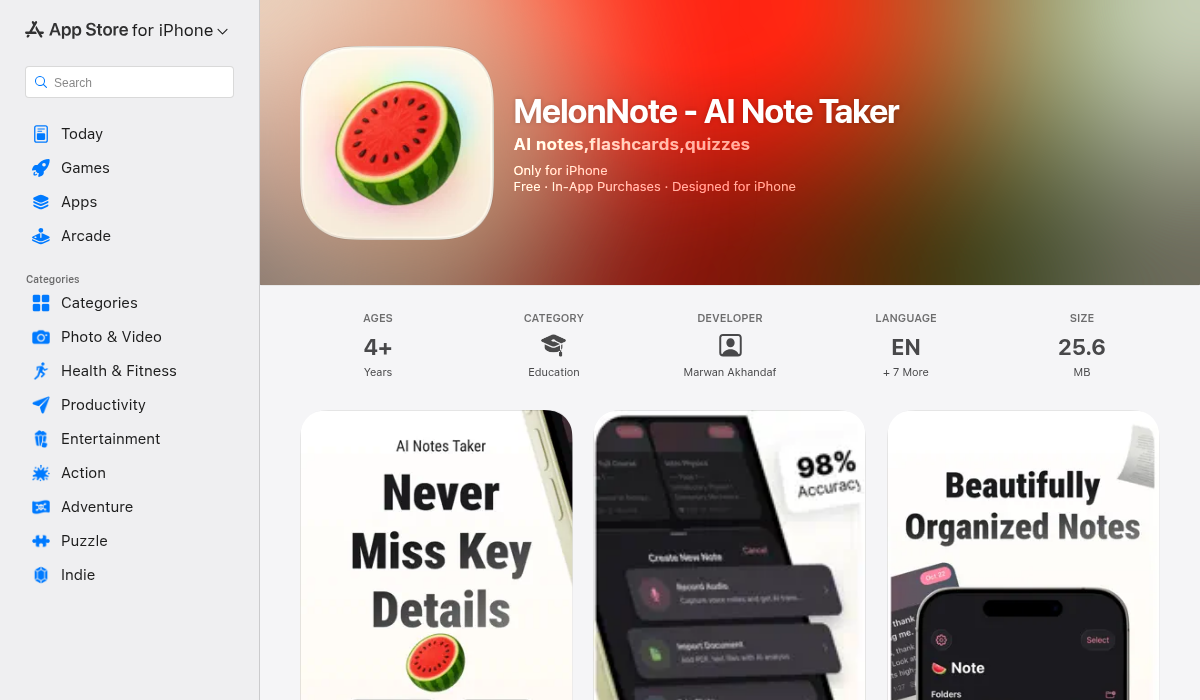
MelonNote stands out as a purpose-built study app that combines everything medical students need. Instead of juggling multiple tools, you get recording, transcription, summarization, flashcards, quizzes, and AI tutoring in one place.
Key features for medical students:
- ✅ Lecture recording + AI transcription — Record 3-hour pathophysiology lectures and get accurate transcripts via OpenAI Whisper
- ✅ PDF import with analysis — Drop in textbook chapters, slides, or papers and the AI extracts key content
- ✅ Photo-to-notes — Snap photos of whiteboards, diagrams, or handwritten notes and AI converts them to text
- ✅ Auto-generated flashcards — AI creates flashcards from any note — no manual creation
- ✅ Practice quizzes — MCQ, true/false, fill-in-blank questions generated from your material
- ✅ AI tutor — Ask questions about your notes and get contextual explanations
- ✅ AI podcast generator — Turns notes into listenable podcasts for commute studying
- ✅ Multi-select study sets — Combine notes across subjects for comprehensive exam prep
"I'm using Hedy AI for lecture transcription and it's fantastic... AI can be inconsistent sometimes and you don't want to lose important lecture content."— Reddit user in r/studying
What makes MelonNote particularly useful for medical students is the study set feature. You can combine anatomy, physiology, and clinical notes into one exam prep set, then generate flashcards and quizzes that cover everything. The AI tutor understands the context of all your combined notes — so you can ask questions like "How does the renin-angiotensin system relate to what we covered in cardiovascular anatomy?"
Unique feature: AI podcasts
MelonNote is the only study app that can turn your notes into a podcast conversation. It generates a two-person discussion about your material that you can listen to while commuting or exercising. For auditory learners or when you need a break from reading, this is genuinely useful.
Pricing: $3.99/month or $49.99/year — significantly cheaper than Otter ($16.99/mo) or combining multiple apps.
5. Goodnotes / Notability
These apps excel at handwriting and PDF annotation with Apple Pencil. Good for visual learners who draw diagrams but limited AI features.
- ✅ Excellent for handwriting and diagrams
- ✅ Goodnotes recently added some AI
- ❌ No lecture recording
- ❌ No flashcard/quiz generation
- ❌ iPad-centric (no Android)
6. Anki
The gold standard for spaced repetition flashcards. Many med students swear by it, but you'll spend hours making cards.
- ✅ Best spaced repetition algorithm
- ✅ Free and powerful
- ❌ No note-taking or recording
- ❌ Manual flashcard creation only
- ❌ Steep learning curve
- ❌ Dated interface
Many students use Anki alongside another app for note capture — which is exactly the fragmented workflow problem.
How to Choose the Right App
Consider your primary study bottleneck:
- If you can't keep up with lectures — You need lecture recording + transcription. Look at MelonNote or Otter.
- If making flashcards takes forever — You need auto-generation. MelonNote creates them from your notes automatically.
- If you struggle with retention — You need active recall tools: quizzes, flashcards, spaced repetition.
- If you need concept explanations — You need an AI tutor that knows your material specifically.
- If you're visual — Goodnotes/Notability for diagrams + another app for transcription.
For most medical students, an all-in-one app eliminates the friction of switching between tools. You're already overwhelmed with information — your tools should simplify, not complicate.
Pro Tips for AI-Powered Studying
- Record everything — Even if you think you'll remember, record it. You can always listen back before exams.
- Import textbook chapters — PDF import lets you generate flashcards and quizzes from required reading, not just lectures.
- Use multi-select for exam prep — Combine all relevant notes into one study set before finals.
- Quiz yourself, don't just re-read — Active recall beats passive review. Use auto-generated quizzes regularly.
- Listen to podcasts during commutes — If your app generates audio, use dead time for passive review.
The Bottom Line
The right AI study app won't just save you time — it'll change how effectively you learn. Medical school is a volume game, and you need tools that compress that volume into actually retainable knowledge.
For students who want one app that does it all — recording, transcription, summaries, flashcards, quizzes, and AI tutoring — MelonNote is worth trying. It's designed for the exact workflow med students need: capture information, transform it into study tools, and use active recall to actually retain it.
The best part? It's affordable enough that you can try it without committing to expensive annual plans. Your future board-exam self will thank you.