Best Apps for Medical Students 2026
Medical school throws more information at you in a single week than most people see in a year. Between anatomy lectures, pharmacology flashcards, clinical rotations, and the occasional attempt at sleep — you need every advantage you can get.
The right apps can genuinely transform how you study, retain information, and survive the fire hose of medical knowledge. We've tested dozens of tools that medical students swear by in 2026, and narrowed it down to the ones that actually make a difference — not just another app collecting dust on your home screen.
Why Med Students Need Specialized Tools
General note-taking apps weren't built for the volume and complexity of medical education. You're not just scribbling meeting notes — you're memorizing thousands of drug interactions, anatomical structures, and clinical pathways. That requires tools designed for serious, high-volume learning.
"The ones I have and find useful are: AO classification, Antibiotic guide, Essential Anatomy, MDCalc... honestly the hardest part is finding apps that actually help you study, not just reference."— Reddit user in r/medicalschool
The challenge isn't finding apps — it's finding the right combination that covers note-taking, memorization, practice testing, and quick clinical reference without juggling six different subscriptions.
Best Apps for Medical Students in 2026
1. MelonNote — The All-in-One AI Study Companion
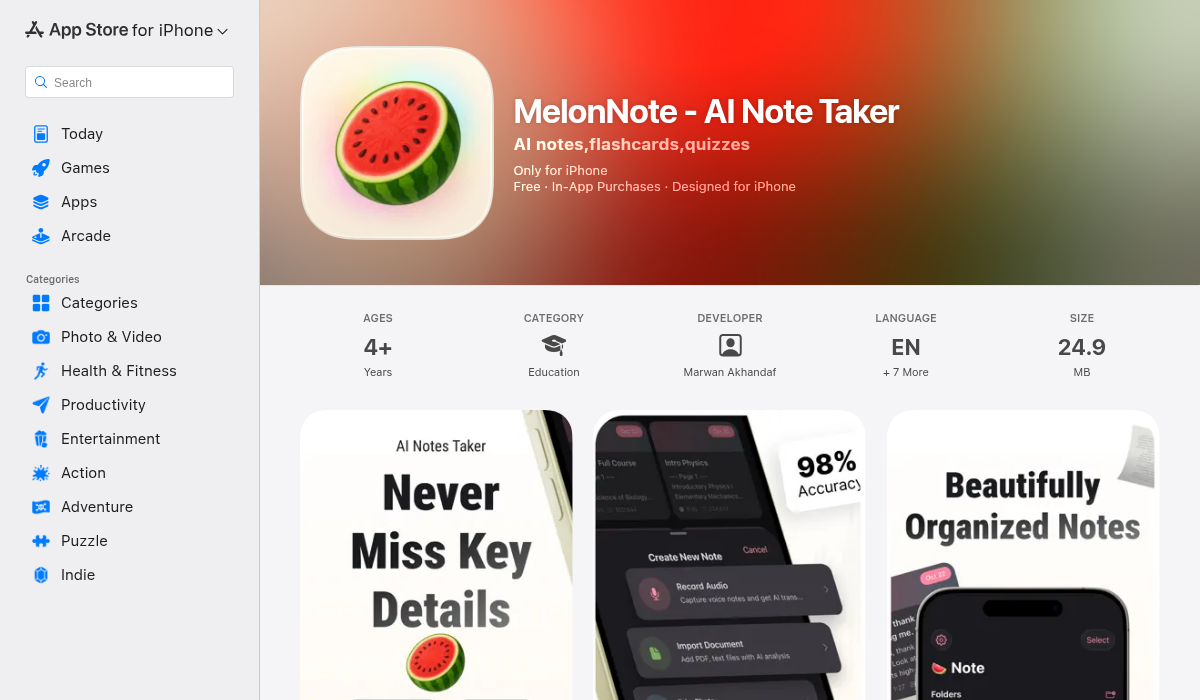
If there's one app that genuinely feels like it was built for the med school grind, it's MelonNote. It replaces what would normally be five or six separate apps — a lecture recorder, transcription service, flashcard maker, quiz generator, AI tutor, and even a podcast player — all in one place.
Here's why medical students love it:
- ✅ Record and transcribe lectures — Hit record during a pharmacology lecture, and MelonNote's AI (powered by OpenAI Whisper) transcribes the entire thing. No more frantic scribbling.
- ✅ Auto-generate flashcards — Once your notes are in, MelonNote creates flashcards automatically. For med students drowning in terminology, this alone saves hours every week.
- ✅ AI-generated quizzes — Multiple choice, true/false, fill-in-the-blank — all generated from your actual notes. It tests comprehension, not just rote memorization.
- ✅ AI tutor chat — Confused about the mechanism of action of a beta-blocker? Ask the AI tutor. It knows your notes and explains concepts in context.
- ✅ Podcast generator — This is the feature that sets MelonNote apart. It turns your lecture notes into a two-person podcast conversation you can listen to while commuting or at the gym. No other study app does this.
- ✅ Import PDFs — Upload textbook chapters, slides, or research papers. MelonNote extracts the text and lets you generate flashcards and quizzes from them.
- ✅ Photo-to-notes — Snap a photo of a whiteboard diagram or handwritten notes, and AI converts it to structured digital text.
- ✅ Realtime AI conversation — Like having a study buddy who actually read all your notes. Talk through difficult concepts out loud.
At $3.99/month (or $49.99/year), it's also significantly cheaper than competitors like Otter.ai ($16.99/mo) or running separate subscriptions for Anki add-ons, Quizlet Plus, and a transcription service. Available on both iOS and Android.
2. Anki — The Spaced Repetition Gold Standard
No list of medical student apps is complete without Anki. It's the spaced repetition flashcard app that has basically become a rite of passage in med school. The algorithm is battle-tested, the community-created deck library (AnkiHub, AnKing) is massive, and it's free on desktop and Android.
- ✅ Incredibly powerful spaced repetition algorithm
- ✅ Massive community decks for USMLE, anatomy, pharmacology
- ✅ Highly customizable card templates
- ❌ Steep learning curve — setup takes time
- ❌ iOS app costs $24.99 (one-time)
- ❌ No lecture recording, AI, or quiz features — flashcards only
Anki excels at long-term memorization, but it's a single-purpose tool. You'll still need other apps for note-taking, recording, and practice testing. Many students pair Anki with a comprehensive tool like MelonNote — use MelonNote for capturing and understanding material, then Anki for drilling it into long-term memory.
3. Brainscape — Polished Flashcards with Medical Content
Brainscape offers a more polished flashcard experience than Anki, with certified medical content for MCAT, USMLE, NCLEX, and more. Its confidence-based repetition system asks you to rate each card 1-5, which some students find more intuitive than Anki's grading system.
- ✅ Clean, modern interface
- ✅ Pre-made certified medical content
- ✅ Detailed learning analytics
- ❌ Most content requires a paid subscription
- ❌ Less customizable than Anki
- ❌ No note-taking or recording features
4. UpToDate — Clinical Reference on the Go
UpToDate is the clinical reference that practicing physicians actually use. Many medical schools provide free access, and having it on your phone during clinical rotations is invaluable. It's evidence-based, regularly updated, and helps bridge the gap between textbook knowledge and real clinical practice.
- ✅ Gold-standard clinical evidence
- ✅ Regularly updated with latest research
- ✅ Drug interactions and dosing calculators
- ❌ Expensive without institutional access
- ❌ Not a study tool — it's a reference
5. MDCalc — Quick Clinical Calculations
Every medical student eventually needs to calculate a GFR, a Wells score, or a MELD score. MDCalc puts over 600 clinical calculators in your pocket. It's free, fast, and explains the evidence behind each calculator — making it both a practical tool and a learning resource.
- ✅ 600+ validated clinical calculators
- ✅ Evidence explanations with each tool
- ✅ Completely free
- ❌ Reference tool only — not for studying
6. Human Anatomy Atlas — 3D Visual Learning
Visible Body's Human Anatomy Atlas gives you a complete 3D model of the human body you can rotate, dissect, and explore. For visual learners, it's far more effective than staring at flat diagrams in a textbook. It covers musculoskeletal, cardiovascular, nervous, and every other system in detail.
- ✅ Stunning 3D models
- ✅ Interactive dissection views
- ✅ Quiz mode for self-testing
- ❌ One-time purchase (~$24.99)
- ❌ Anatomy-specific only
How to Build Your Med School App Stack
The key isn't downloading every app on this list — it's building a workflow that covers the full study cycle:
- Capture — Record lectures and import materials (MelonNote handles this)
- Understand — Summarize, ask questions, talk through concepts (MelonNote's AI tutor and conversation features)
- Memorize — Flashcards with spaced repetition (MelonNote's auto-generated cards, or Anki for hardcore drilling)
- Test — Practice quizzes and self-assessment (MelonNote's quiz generator)
- Reference — Quick clinical lookups during rotations (UpToDate, MDCalc)
- Reinforce — Listen to your notes as podcasts during downtime (MelonNote's podcast feature)
A solid starting stack: MelonNote for the entire study workflow + MDCalc for clinical rotations. That covers 90% of what most med students need. Add Anki if you want dedicated long-term memorization drills, and UpToDate when you start seeing patients.
Pro Tips for Med School Studying
- Record every lecture — Even if you think you'll remember, you won't. Having a transcript to generate flashcards from later is invaluable.
- Listen during commutes — Use MelonNote's podcast feature to turn dead time into study time. A 20-minute commute is 100 minutes of passive review per week.
- Test yourself constantly — Research consistently shows that active recall (testing) beats passive review (re-reading) for retention. Auto-generated quizzes make this effortless.
- Combine notes for exam prep — MelonNote's multi-select feature lets you combine notes across multiple lectures into one comprehensive study set. Perfect for block exams.
- Don't try to memorize everything on day one — Use spaced repetition to spread the load. Your brain consolidates information over time, not in one marathon session.
The Bottom Line
Medical school in 2026 doesn't have to mean drowning in paper notes and spending hours making flashcards by hand. AI-powered tools have fundamentally changed what's possible — from automatic lecture transcription to instant quiz generation to turning your notes into podcasts you can listen to anywhere.
For most medical students, MelonNote is the single best starting point because it covers the entire study workflow in one app. Pair it with a clinical reference like MDCalc, and you've got a lean, powerful toolkit that actually helps you learn — not just organize.