
Boxing Training at Home: Complete Guide to Getting Started in 2026
You don't need a gym membership or expensive equipment to train like a boxer—your living room works just fine.
Boxing has exploded in popularity as a home workout, and for good reason. It's a full-body cardio blast that builds strength, coordination, and mental toughness. Whether you're looking to get in fighting shape, burn serious calories, or just punch out the stress of the day, boxing at home is accessible, effective, and—let's be honest—way more fun than a treadmill.
Why Boxing Works for Home Fitness
Boxing combines cardio, strength training, and skill development into a single workout. In 30 minutes of shadow boxing, you're engaging your arms, shoulders, core, and legs while keeping your heart rate elevated. It's the efficiency that makes it perfect for busy people working out at home.
The other advantage? Minimal space requirements. Shadow boxing needs about the same floor space as a yoga mat. Add a jump rope and you've got a complete cardio program. A heavy bag is nice to have but absolutely not required.
Getting Started: The Basics
Before throwing punches, you need the fundamentals. Proper form protects your joints and makes your training actually effective.
Your Stance
Stand with feet shoulder-width apart, dominant foot slightly back. Knees bent, weight distributed evenly. Hands up protecting your face, elbows tucked in. This is your "home base"—every punch starts and ends here.
The Four Basic Punches
- Jab — Quick, straight punch from your lead hand. Sets up everything else.
- Cross — Powerful straight punch from your rear hand, rotating from your hips.
- Hook — Curved punch targeting the side of the head or body. Elbow bent at 90 degrees.
- Uppercut — Rising punch from below, targeting the chin or body.
Master these four and you can build infinite combinations.
The At-Home Boxing Workout
Here's a structure that mirrors real boxing training:
Warm-Up (5 Minutes)
- Jump rope or jumping jacks — 2 minutes
- Arm circles and shoulder rolls — 1 minute
- Light shadow boxing, no power — 2 minutes
Rounds (15-20 Minutes)
Boxing is trained in rounds, typically 3 minutes of work followed by 30-60 seconds of rest. Start with shorter rounds (2 minutes) if you're new.
Round 1-2: Basic combinations. Jab-cross. Jab-jab-cross. Focus on form over speed.
Round 3-4: Add hooks. Jab-cross-hook. Move your feet between combinations—boxers never stand still.
Round 5-6: Include uppercuts and defense. Slip imaginary punches, then counter. This is where it gets fun.
Conditioning (10 Minutes)
- Burpees — 3 sets of 10
- Push-ups — 3 sets of 15
- Plank holds — 3 sets of 30 seconds
- Mountain climbers — 3 sets of 20
Cool Down (5 Minutes)
Stretching is crucial. Boxing tightens the shoulders, chest, and hips. Take time to stretch everything out.
The Timer Is Everything
Here's what separates real boxing training from just "throwing punches"—the structure. Rounds matter. Rest periods matter. Without a timer keeping you honest, it's too easy to take unearned breaks or cut rounds short.
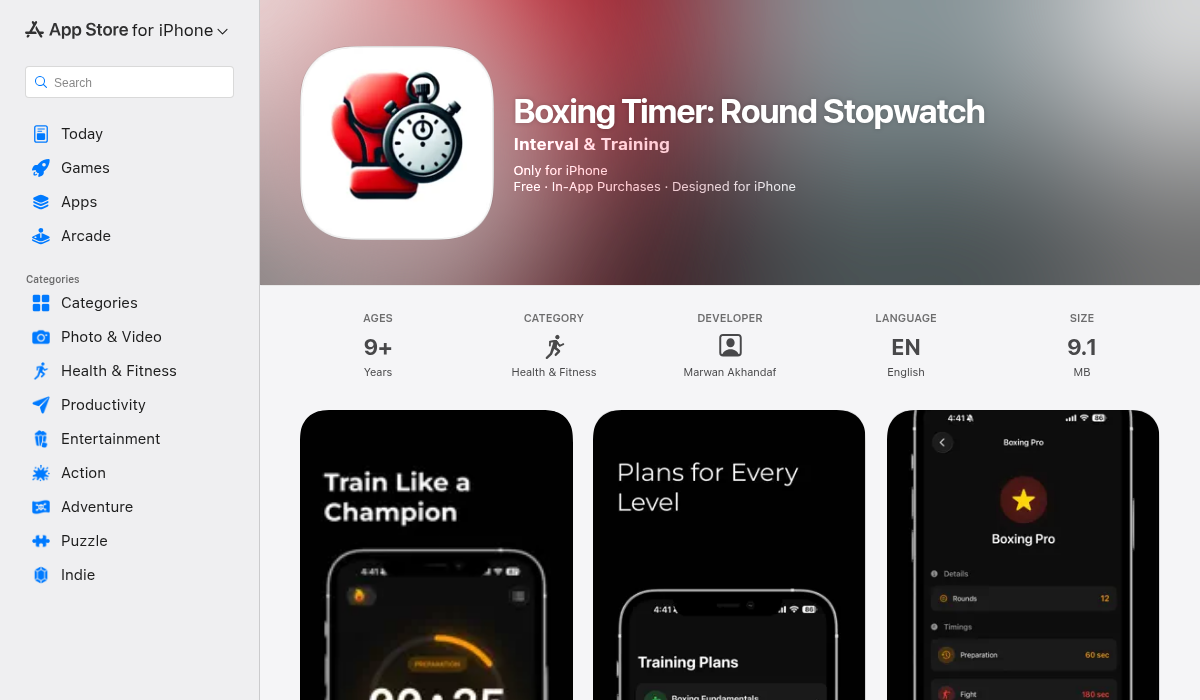
Boxing Timer handles this beautifully. You set your round length, rest period, and total rounds, then let it run. Audio cues tell you when to start and stop, so you can focus entirely on your training without watching a clock.
- ✅ Adjustable round and rest timers
- ✅ Multiple boxer profiles (different workout structures saved)
- ✅ Session tracking to see your progress
- ✅ AI voice coach (premium) for motivation during rounds
- ✅ Apple Health sync to track boxing as exercise
The difference between training with a proper round timer and just "working out until tired" is enormous. Structure forces intensity.
Equipment Worth Getting (Eventually)
You can train boxing with zero equipment, but a few items make home training significantly better:
Jump Rope — Essential
Every boxer jumps rope. It builds footwork, conditioning, and rhythm. A basic speed rope costs under $15 and lasts for years.
Hand Wraps — Important If You'll Hit Things
If you're punching anything harder than air—heavy bags, pads, even a mattress—hand wraps protect your wrists and knuckles. Learn to wrap properly before hitting anything solid.
Heavy Bag — Nice to Have
A heavy bag adds resistance and feedback that shadow boxing can't provide. Free-standing bags work for apartments (no ceiling mount required), though they move more than hanging bags.
Mirror — Surprisingly Useful
Boxers train in front of mirrors to check their form. Seeing yourself throw punches reveals habits you'd never notice otherwise—dropping your hands, telegraphing punches, unbalanced footwork.
Common Mistakes to Avoid
Dropping Your Hands
After throwing a punch, bring your hand back to guard position immediately. In a real fight, dropped hands mean getting hit. In training, it builds bad habits and reduces core engagement.
Ignoring Defense
Shadow boxing isn't just throwing punches—it's slipping, bobbing, and weaving too. Imagine punches coming at you. Move your head. This builds the neural pathways that make defense instinctive.
Going Too Hard Too Soon
Technique first, power second. Throwing max-power punches with bad form is how you hurt your shoulders and wrists. Slow down, nail the mechanics, then gradually add speed and power.
Forgetting to Breathe
Exhale sharply with each punch. This engages your core, increases power, and prevents you from gassing out. Listen to any professional boxer—you'll hear them exhale with every strike.
Learning Resources
YouTube is packed with quality boxing instruction. Channels like FightTips, Tony Jeffries (Olympic medalist), and Precision Striking offer free tutorials on everything from basic punches to advanced combinations.
For complete beginners, start with their "fundamentals" playlists. Learn the stance, the four basic punches, and basic footwork before moving to combinations.
Building a Sustainable Practice
The best workout is one you actually do consistently. Here's how to make boxing training stick:
- Start with 3 days per week — Boxing is intense. Your body needs recovery, especially at the beginning.
- Keep sessions manageable — 20-30 minutes is plenty when you're starting. You can always add more later.
- Track your sessions — Knowing you trained 15 times this month (versus "a bunch") builds momentum and accountability.
- Mix it up — Some days focus on technique (slow, precise). Some days focus on cardio (higher tempo). Some days just go hard. Variety prevents burnout.
- Set round-based goals — "6 rounds today" is more concrete than "workout for 30 minutes." A timer app makes this automatic.
The Mental Benefits
Boxing isn't just physical. There's something uniquely satisfying about throwing punches—it's an acceptable, constructive way to process aggression and stress. After a good boxing session, mental fog clears. Tension releases. The problems that felt overwhelming somehow shrink.
The focus required during training is also meditative. When you're thinking about combinations, footwork, and breathing, you're not thinking about work emails or relationship drama. It's enforced presence.
The Bottom Line
Boxing at home is one of the most effective, space-efficient, and genuinely enjoyable ways to get fit. You need minimal equipment, minimal space, and the barrier to entry is just showing up and throwing punches.
Start simple: learn your stance, master the four basic punches, and use a proper round timer to structure your training. The timer is honestly the game-changer—it's the difference between "messing around" and "actually training."
Put on some music, set your rounds, and start punching. Your future self—stronger, leaner, and significantly less stressed—will thank you.