
Can AI Detect Fake Halal Certification? What Apps Can Do
A ham sandwich with a fake halal label. 40 years of fraudulent meat smuggling. Reports to food safety agencies hitting five-year highs. The halal certification fraud problem is real — and it's getting worse.
For the 1.8 billion Muslims worldwide who rely on halal certification to follow their faith, this is more than a labeling issue. It's a betrayal of trust. And with the global halal food market projected to reach $1.5 trillion by 2033, the financial incentives for fraud have never been higher.
So here's the question everyone's asking: can AI and smartphone apps actually detect fake halal certification? The answer is more nuanced than you might think — and understanding what technology can (and can't) do could save you from unknowingly consuming haram products.
The Growing Crisis of Halal Certification Fraud
In December 2025, the UK's Food Standards Agency revealed a troubling trend: halal food fraud reports hit a five-year high, with 16 complaints filed in 2024 alone — up from zero in 2020. Half of these involved non-halal meat being misrepresented as certified halal.
But experts say this is just the "tip of the iceberg."
"It's the tip of the iceberg in terms of the number of halal food frauds that are reported. We are also finding businesses are fraudulently using certification marks without any prior permission."— Nadeem Adam, Halal Monitoring Committee (UK)
The problem isn't limited to the UK. In January 2025, Malaysia — a country with some of the strictest halal standards in the world — was rocked by a scandal when a ham sandwich bearing a fake halal logo was discovered in a convenience store. This came just years after the devastating revelation that a meat cartel had been smuggling non-halal meat into the country for over 40 years.
Meanwhile, in the United States, a 2023 Halal Food Council study estimated that 10-15% of halal-labeled products may carry dubious certifications. The US halal market — worth $668.7 billion — lacks unified federal oversight, creating a patchwork system that fraudsters exploit.
Why Fake Halal Certification is So Profitable
The economics of fraud are simple: halal meat costs approximately 20% more than conventional meat. Producing genuinely halal meat requires trained slaughterers, segregated facilities, and rigorous documentation. Slapping a fake logo on regular meat? That costs nothing.
The fragmented nature of halal certification makes enforcement nearly impossible. In the US alone, over 20 certification bodies operate with varying standards. Some, like IFANCA and ISA, enforce rigorous on-site audits. Others issue logos without proper verification. Consumers have no way to distinguish between them.
"I recently saw a documentary talking about how a lot of halal certification is faked, and people are tricked into believing they're real. Even some 'halal' brands will stun the chicken to the point where it dies."— Reddit user, r/islam
What AI Can Actually Do (And What It Can't)
Here's where we need to set realistic expectations. AI cannot verify if a halal certification certificate is real or forged. No app can call up a certification body's database, cross-reference a document number, and confirm authenticity. That infrastructure simply doesn't exist in most markets.
What AI can do is analyze the actual ingredients in a product.
This is a crucial distinction. While apps can't tell you if the logo on a package is genuine, they can scan the ingredient list and identify potentially haram additives — things like:
- E120 (Carmine) — Derived from insects, considered haram by most scholars
- E441 (Gelatin) — Often sourced from pork or non-zabiha animals
- E471 (Mono/Diglycerides) — Can be plant or animal-derived (mushbooh)
- Hidden alcohol — Used as a carrier in many flavorings
This matters because even products with legitimate halal certification can contain questionable ingredients if the certification body has lenient standards or made an oversight. AI ingredient analysis acts as a second line of defense.
How Modern Halal Scanner Apps Work
The latest generation of halal food scanner apps use multiple approaches to help consumers make informed decisions:
1. Barcode Database Lookup
Apps maintain databases of millions of products with pre-verified halal status. Scan a barcode, and you get an instant verdict. The limitation? Products not in the database — especially regional or new items — won't return results.
2. AI Ingredient Analysis
When a product isn't in the database, advanced apps let you photograph the ingredient list. AI then identifies each component and flags anything potentially haram. This is particularly useful for the thousands of E-numbers and chemical additives that most people can't identify.
3. Additive Classification
Good apps classify ingredients into clear categories:
- Halal (حلال) — Safe, vegetarian origin
- Mushbooh (مشبوه) — Doubtful, could be plant or animal-derived
- Haram (حرام) — Contains animal or alcohol-derived ingredients
- Unknown — Needs further research
Best Apps for Halal Ingredient Verification
Mustakshif Halal Checker
Mustakshif focuses on barcode scanning and maintains a large product database. It offers scholar-verified guidance for many additives and E-numbers.
- ✅ Large product database
- ✅ E-number lookup
- ❌ Limited AI ingredient scanning
- ❌ Database gaps for regional products
HalalFoodScan
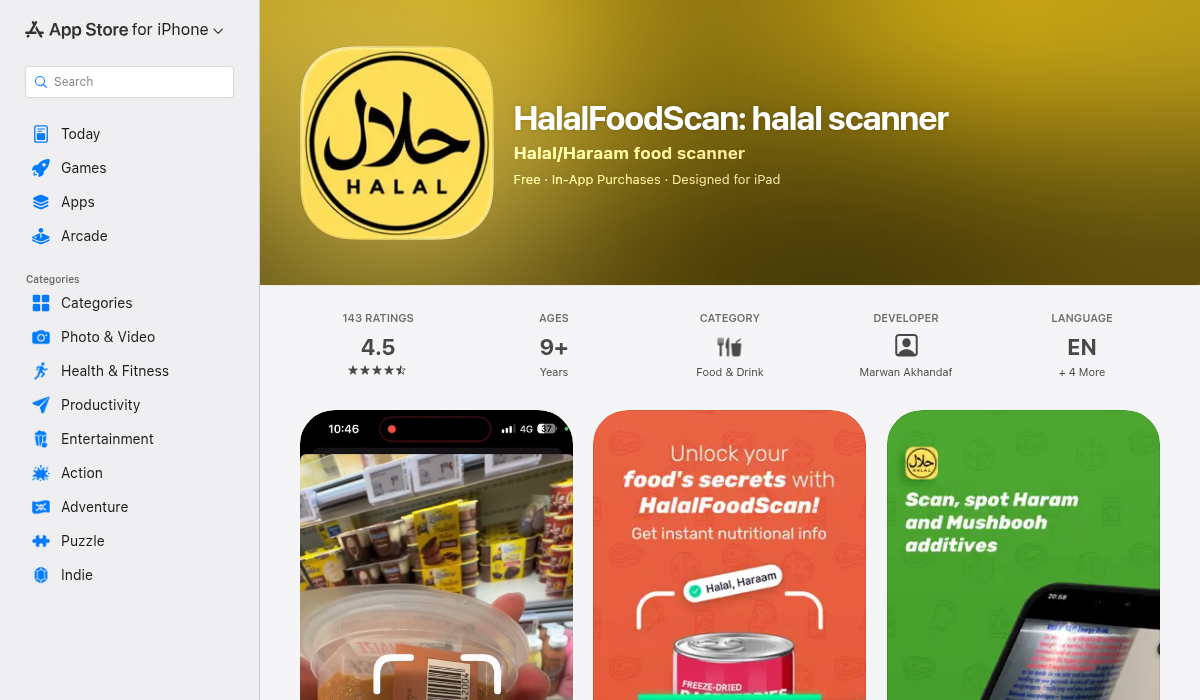
HalalFoodScan combines barcode scanning with AI-powered ingredient analysis. When a product isn't in the database, you can photograph the back of the package and the AI will analyze every additive it detects.
- ✅ Barcode scanning + AI ingredient analysis
- ✅ Special vinegar detection feature (addresses common questions about alcohol in vinegar)
- ✅ Works on products not in database
- ✅ Detailed additive explanations
- ✅ No data collected — privacy-focused
The vinegar feature is particularly useful because many Muslims are confused about whether vinegar is halal. According to authentic hadith, the Prophet Muhammad ﷺ said:
"What an excellent condiment vinegar is."— Prophet Muhammad ﷺ (Sahih Muslim 2052)
Islamic scholars agree that vinegar — even wine vinegar — is halal because the alcohol has completely transformed (istihalah) into acetic acid. HalalFoodScan explains this to users when vinegar-based products are scanned.
The Limits of Technology: What You Still Need to Know
No matter how advanced these apps become, they cannot solve the certification fraud problem entirely. Here's why:
1. Apps Can't Verify Slaughter Methods
For meat to be halal, it must be slaughtered by a Muslim (or person of the book), with the name of Allah pronounced, using a swift cut to the throat while the animal is alive. No app can verify this happened. You're still relying on the integrity of the supply chain.
2. Cross-Contamination is Invisible
Even if ingredients are halal, products processed in shared facilities may be contaminated with haram substances. Apps can't detect this.
3. Certification Body Quality Varies
A product bearing a legitimate certification from a lenient body may still contain questionable ingredients. The app helps you verify what's in the product regardless of what logo is on the package.
How to Protect Yourself: A Practical Approach
Given the limitations of both technology and certification systems, here's a practical strategy:
- Use a halal scanner app — Verify ingredients independently, especially for packaged foods with many additives
- Know your certification bodies — Research which certifiers in your region have the strictest standards (JAKIM in Malaysia, HMC in the UK, IFANCA in the US)
- For meat, buy from trusted sources — A local halal butcher you know personally is more reliable than supermarket meat with a logo you can't verify
- When in doubt, avoid — The Prophet ﷺ advised caution in doubtful matters
"What is lawful is clear and what is unlawful is clear, and between them are doubtful matters unknown to most people. So whoever avoids doubtful matters has protected his religion and his honor."— Prophet Muhammad ﷺ (Sahih Bukhari 5527)
The Future: Blockchain and QR Verification
Industry efforts are underway to combat fraud at a systemic level. Malaysia's JAKIM is digitizing halal certificates and adding QR codes to packaging that link to verified certification records. A 2025 IFANCA project is trialing AI to detect fake logos by analyzing packaging patterns.
Until these systems are widespread, smartphone apps remain the most practical tool for individual consumers to verify what's actually in their food.
The Bottom Line
Can AI detect fake halal certification? Not directly — no app can verify if a certificate is forged. But AI can analyze ingredients, identify hidden haram additives, and give you information the certification logo alone doesn't provide.
In a market where 10-15% of halal-labeled products may be fraudulent, that second layer of verification isn't just useful. It's essential.
If you want to scan ingredients and get instant halal status for food products — including items not in standard databases — HalalFoodScan is worth trying. It won't solve certification fraud, but it will tell you what's actually in that package before you buy it.
Note: For specific religious rulings (fatwa), always consult with qualified Islamic scholars or your local imam. This article provides general information based on recognized Islamic sources.