
Complete Guide to Halal E-Numbers: What Muslims Need to Know in 2026
Complete Guide to Halal E-Numbers: What Muslims Need to Know in 2026. Read our comprehensive guide with expert tips, comparisons, and everything you need to kno
You're standing in a supermarket aisle, flipping a package over to check the ingredients, and you see: E471, E120, E422. What do these cryptic codes mean? More importantly—are they halal?
For millions of Muslims worldwide, deciphering E-numbers has become an essential yet exhausting part of grocery shopping. These European food additive codes hide everything from plant-based colorings to pork-derived emulsifiers, and without proper knowledge, it's nearly impossible to tell them apart. This complete guide breaks down everything you need to know about halal E-numbers in 2026.
What Are E-Numbers and Why Do They Matter?
E-numbers are standardized codes for food additives used across Europe and internationally. The "E" originally stood for "Europe," where the Scientific Committee on Food developed this classification system in the 1960s. Each number represents a specific additive—preservatives, colorings, emulsifiers, thickeners, and more.
While these additives serve important functions (extending shelf life, improving texture, enhancing flavor), their sources vary dramatically. Some are purely synthetic or plant-based, while others derive from animal sources that may include pork or non-halal slaughtered animals.
"O you who believe! Eat of the good things which We have provided for you, and be grateful to Allah, if it is Him you worship."— Quran, Surah Al-Baqarah 2:172
This Quranic verse reminds us that Muslims are commanded to eat from what is tayyib (good and pure). Understanding what's actually in our food isn't just about religious compliance—it's about honoring the principle of mindful, conscious consumption.
The E-Number Classification System
E-numbers are organized by function into specific ranges. Understanding these categories helps you quickly identify what type of additive you're looking at:
- E100–E199: Colors (food dyes and pigments)
- E200–E299: Preservatives (prevent spoilage)
- E300–E399: Antioxidants and acidity regulators
- E400–E499: Thickeners, stabilizers, and emulsifiers
- E500–E599: Acidity regulators and anti-caking agents
- E600–E699: Flavor enhancers
- E900–E999: Glazing agents, gases, and sweeteners
- E1000–E1999: Additional chemicals and modified starches
The trickiest categories for Muslims are E400–E499 (emulsifiers often derived from animal fats) and certain colorings like E120 (carmine, from insects). Let's examine the most problematic E-numbers in detail.
Haram and Mushbooh E-Numbers: The Complete List
Based on guidance from recognized Islamic certification bodies including JAKIM (Malaysia), IFANCA (USA), and the Islamic Services of America, here are the E-numbers Muslims should avoid or verify:
Definitely Haram
- E120 (Carmine/Cochineal): A red dye derived from crushed cochineal insects. Used in candies, yogurts, and beverages. Always haram according to the majority of scholars.
- E441 (Gelatin): When derived from pork or non-halal slaughtered animals. Common in gummies, marshmallows, and desserts.
- E542 (Edible Bone Phosphate): Derived from animal bones—haram if from pork or non-halal sources.
- E904 (Shellac): A resin secreted by lac insects, used as a glazing agent on candies and fruits. Considered haram by most scholars.
Mushbooh (Doubtful—Requires Verification)
These additives can be derived from either halal or haram sources:
- E422 (Glycerol/Glycerin): Can be plant-based (halal) or derived from animal fat (potentially haram). Must verify the source.
- E471 (Mono and Diglycerides): Fatty acid derivatives that could come from vegetables or animal sources. Very common in baked goods and margarine.
- E472a-f (Various Esters): Similar to E471—source dependent.
- E473 (Sucrose Esters): Can be from plant or animal fatty acids.
- E474 (Sucroglycerides): Source-dependent.
- E475 (Polyglycerol Esters): May contain animal-derived components.
- E476 (Polyglycerol Polyricinoleate): Usually plant-based, but verify.
- E477-E483: Various emulsifiers that require source verification.
- E491-E495 (Sorbitan Esters): Can be from animal or plant fatty acids.
- E570 (Stearic Acid/Fatty Acids): Common in confectionery—often animal-derived.
- E631 (Disodium Inosinate): Can be from fish, meat, or sardines.
- E635 (Disodium Ribonucleotides): Often from animal sources.
Generally Halal E-Numbers
These are typically safe for Muslims:
- E100 (Curcumin): Yellow color from turmeric—plant-based, halal.
- E101 (Riboflavin/Vitamin B2): Usually synthetic or plant-derived.
- E140-E141 (Chlorophylls): Green pigments from plants.
- E150a-d (Caramel Colors): Made from heated sugars.
- E160a (Carotenes): From carrots and other plants.
- E162 (Beetroot Red): Natural plant color.
- E170 (Calcium Carbonate): Mineral-based.
- E200-E203 (Sorbic Acid and Sorbates): Synthetic preservatives.
- E210-E213 (Benzoic Acid and Benzoates): Synthetic.
- E300-E304 (Ascorbic Acid/Vitamin C): Synthetic or plant-derived.
- E306-E309 (Tocopherols/Vitamin E): Usually from plant oils.
- E322 (Lecithin): Typically from soy—halal, but verify source.
- E330-E333 (Citric Acid and Citrates): From citrus or fermentation.
- E400-E418 (Alginates, Carrageenan, Gums): From seaweed and plants.
- E440 (Pectins): From fruit.
The Vinegar Question: E260 and Alcohol-Based Additives
One of the most debated topics in halal food is whether vinegar (E260 - Acetic Acid) made from wine is permissible. This deserves special attention.
"What an excellent condiment vinegar is."— Prophet Muhammad ﷺ (Sahih Muslim 2052)
The scholarly consensus, supported by hadith in Sahih Bukhari (5205) documenting that the Prophet ﷺ ate vinegar with bread, is that vinegar is halal regardless of its original source. This is based on the principle of istihalah (complete transformation)—when a substance transforms entirely into a different substance, its ruling changes.
During vinegar production, alcohol completely converts to acetic acid through bacterial fermentation. No intoxicating properties remain. Major Islamic bodies including JAKIM, MUI, and IFANCA consider wine vinegar halal based on this transformation.
However, ingredients that still contain alcohol or where transformation is incomplete remain haram, such as:
- Wine-flavored products where alcohol hasn't fully converted
- Foods cooked with wine where alcohol remains
- Flavor extracts with alcohol as a carrier
Why Checking E-Numbers Is So Difficult
The real challenge with E-numbers isn't memorizing a list—it's that the same code can be halal or haram depending on the source. E471, for example, appears in thousands of products. In one brand's cookies, it might come from soy. In another's, from beef tallow. In a third, from pork fat.
Manufacturers rarely specify the source on labels. You'd need to contact each company individually—and even then, they may not know or may change suppliers.
This is where technology can help.
Best Apps for Checking Halal E-Numbers
Halal Check
Halal Check is one of the original E-number checking apps. You manually search for codes and it tells you if they're halal, haram, or doubtful.
- ✅ Simple interface
- ✅ Covers most E-numbers
- ❌ Manual lookup only—no barcode scanning
- ❌ Doesn't check actual products, just codes
- ❌ Can't tell you the source in a specific product
HalalFoodScan
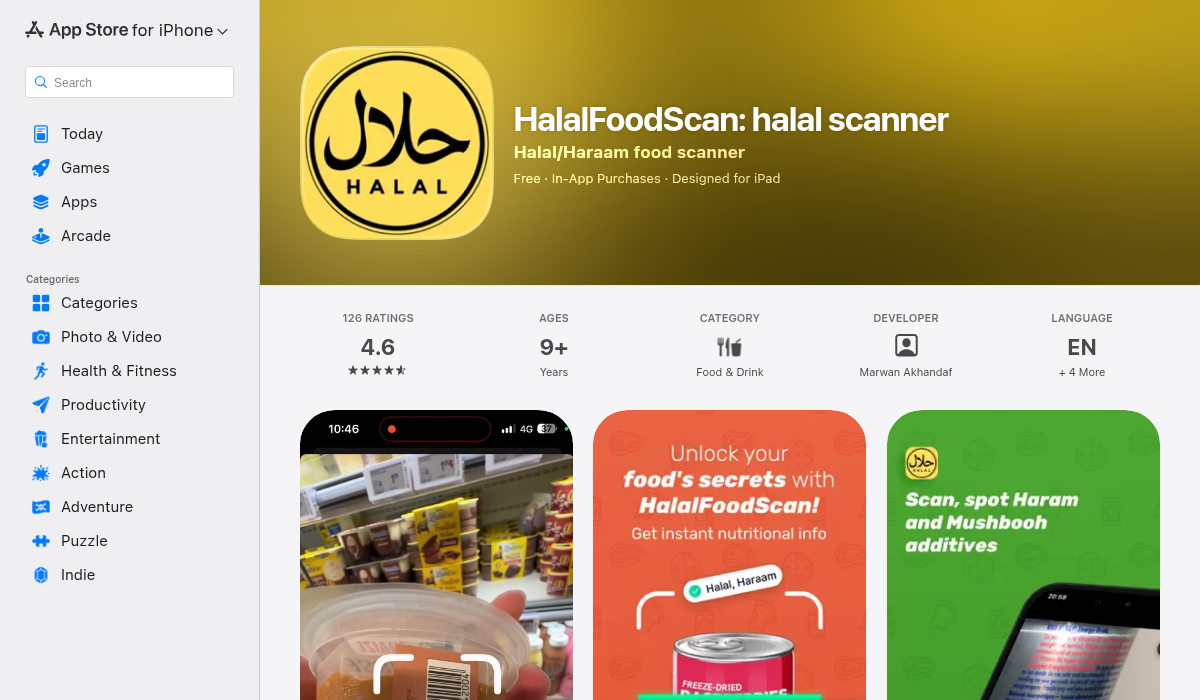
HalalFoodScan takes a different approach. Instead of just checking codes, it scans actual product barcodes and tells you the halal status of that specific product—including whether the E-numbers in it are from halal sources.
- ✅ Barcode scanning for millions of products
- ✅ Instant Halal/Haram/Mushbooh classification
- ✅ AI-powered ingredient analysis for products not in database
- ✅ Detailed additive breakdown with E-number detection
- ✅ Special vinegar detection feature with scholarly explanations
- ✅ No data collected—privacy-focused
- ✅ Available in English, Arabic, Dutch, French, Spanish
What makes HalalFoodScan particularly useful is its additive analysis feature. For products not in its database, you can scan the ingredients list on the back of the package. The AI identifies all E-numbers and additives, then provides the halal status of each one with explanations.
Pro Tips for Navigating Halal E-Numbers
- Focus on the high-risk categories: E400s (emulsifiers) and E900s (glazing agents) are most likely to contain animal-derived ingredients. Pay extra attention to these.
- Look for halal certification first: If a product carries certification from a recognized body (IFANCA, JAKIM, MUI, HMC), they've already verified the E-numbers. Trust the certification.
- When in doubt about E471, assume animal source: This is the most common problematic E-number. Unless the product is certified halal or explicitly states "plant-based emulsifiers," it's safer to avoid.
- Learn the definitely-haram ones: E120 (carmine), E441 (gelatin), E542 (bone phosphate), and E904 (shellac) are almost always haram. Memorizing just these four covers most situations.
- Use technology: Apps like HalalFoodScan can check products in seconds. It's faster and more reliable than manual lookup.
- Check for "suitable for vegetarians": While not a guarantee (some vegetarian products may contain alcohol-derived ingredients), this label often indicates plant-based additives.
The Islamic Perspective on Food Additives
It's worth remembering the broader Islamic principle here. Allah says in the Quran:
"He has only forbidden to you dead animals, blood, the flesh of swine, and that which has been dedicated to other than Allah. But whoever is forced by necessity, neither desiring it nor transgressing its limit—there is no sin upon him."— Quran, Surah Al-Baqarah 2:173
The principle of necessity (darurah) applies. If you're in a situation where halal food isn't available and you must eat, Allah is Most Merciful. However, in normal circumstances where we have choices—and in 2026, we certainly do—we should strive to eat what is clearly halal and pure.
As the Prophet ﷺ said: "What is lawful is clear and what is unlawful is clear, and between them are matters unclear that many people do not know. He who guards against the unclear matters keeps his religion and honor blameless." (Sahih Bukhari 52)
The Bottom Line
E-numbers don't have to be a source of anxiety. With the right knowledge and tools, checking food additives becomes second nature. Remember:
- Definitely avoid: E120, E441 (pork gelatin), E542, E904
- Verify the source: E422, E471, E472-483, E491-495, E570
- Generally safe: E100-199 (most colors), E200-299 (most preservatives), E300-399, E400-440 (plant gums)
When in doubt, use a tool like HalalFoodScan to scan products directly—it takes the guesswork out of grocery shopping and gives you peace of mind that what you're eating aligns with your values.
Note: For specific religious rulings (fatwa), always consult with qualified Islamic scholars or your local imam. This article provides general information based on recognized Islamic sources including the Quran, authentic Hadith, and guidance from major halal certification bodies.