
Dangerous Food Additives to Avoid: A Complete Guide
That innocent-looking ingredient list on your snack bar? It might be hiding some concerning chemicals.
With the FDA announcing a ban on synthetic food dyes by the end of 2026, there's never been a better time to understand what's actually in your food. From artificial sweeteners linked to gut health issues to preservatives that are already banned in Europe — the average American consumes over 10 pounds of food additives every year. Let's break down which ones deserve a second look and how to spot them before they end up in your cart.
Why Food Additives Are Getting So Much Attention
The conversation around food additives has exploded in recent years. The FDA's upcoming synthetic dye ban is just the tip of the iceberg — many additives still legal in the US have been restricted or banned in the European Union for years.
"Artificial sweeteners, all gums, and soy/sunflower lecithins are my hard nos. The more I read about them, the more I try to avoid ultra-processed foods entirely."— Reddit user in r/ultraprocessedfood
But here's the thing — not all additives are created equal. Some are perfectly safe, while others warrant real caution. The challenge is knowing which is which when you're standing in the grocery aisle trying to decode a label.
The Most Concerning Additives to Watch For
Based on current research and regulatory trends, here are the additives that nutrition experts and health-conscious consumers are most concerned about:
Artificial Food Dyes (E102, E110, E129)
Red 40, Yellow 5, and Yellow 6 make up about 90% of all dyes used in US foods. The FDA's 2026 ban is a clear signal — these synthetic colors derived from petroleum have been linked to behavioral issues in children and allergic reactions. Europe requires warning labels on foods containing them.
- ❌ Found in: Candy, cereals, sports drinks, baked goods
- ❌ Look for: "FD&C" followed by a color name
- ✅ Alternatives: Beet juice, turmeric, spirulina for natural coloring
Sodium Nitrite/Nitrate (E250, E251)
These preservatives keep processed meats looking pink and prevent bacterial growth. However, when cooked at high temperatures, they can form nitrosamines — compounds linked to increased cancer risk. The WHO classifies processed meats as Group 1 carcinogens, partly due to these additives.
- ❌ Found in: Bacon, hot dogs, deli meats, sausages
- ✅ Better choice: Look for "uncured" options using celery powder
BHA and BHT (E320, E321)
These synthetic antioxidants extend shelf life in cereals, chips, and chewing gum. BHA is "reasonably anticipated to be a human carcinogen" according to the National Toxicology Program. Many European countries have restricted their use.
- ❌ Found in: Breakfast cereals, potato chips, gum, butter
- ✅ Alternatives: Vitamin E (tocopherols) works as a natural preservative
High Fructose Corn Syrup
While technically not an additive in the traditional sense, HFCS is everywhere and metabolized differently than regular sugar. It's been linked to obesity, fatty liver disease, and insulin resistance when consumed in typical American quantities.
- ❌ Found in: Sodas, bread, condiments, yogurt, salad dressings
- ✅ Better choice: Products sweetened with honey, maple syrup, or regular cane sugar
Artificial Sweeteners (E951, E950, E952)
Aspartame, acesulfame-K, and sucralose are calorie-free but not controversy-free. Recent studies suggest they may disrupt gut microbiome and paradoxically increase cravings for sweet foods.
"The produce section gets treated with fungicides, mineral oils, and waxes that never make it onto the nutrition label. Reading ingredients isn't enough anymore."— Reddit user in r/nutrition
Sodium Benzoate (E211)
A common preservative in acidic foods that can form benzene (a known carcinogen) when combined with vitamin C. This reaction has caused recalls in the beverage industry.
- ❌ Found in: Sodas, fruit juices, pickles, salad dressings
- ❌ Warning: Check if product also contains ascorbic acid/vitamin C
Carrageenan (E407)
Extracted from seaweed, carrageenan is used as a thickener in dairy alternatives and deli meats. Some studies link it to digestive inflammation, though the research is mixed.
- ❌ Found in: Almond milk, coconut milk, ice cream, deli meats
- ✅ Alternative: Guar gum or locust bean gum are gentler options
Insect-Derived Additives You Might Not Expect
For those avoiding animal products or following halal/kosher diets, some additives fly under the radar:
- E120 (Carmine/Cochineal) — Red dye derived from crushed beetles. Found in yogurt, candy, and cosmetics.
- E904 (Shellac) — A resin secreted by lac bugs. Used to make candies and pills shiny.
- E901 (Beeswax) — Bee product used as a glazing agent.
How to Actually Check Your Food
Reading ingredient lists is a start, but most people don't have a chemistry degree. That's where food scanning apps come in.
Yuka

Yuka gives products an overall health score from 0-100 based on nutritional content, additives, and organic status. It's well-designed and popular.
- ✅ Simple color-coded scores
- ✅ Also scans cosmetics
- ❌ Requires subscription for full features
- ❌ Doesn't specifically flag insect-derived ingredients
FoodCheckr
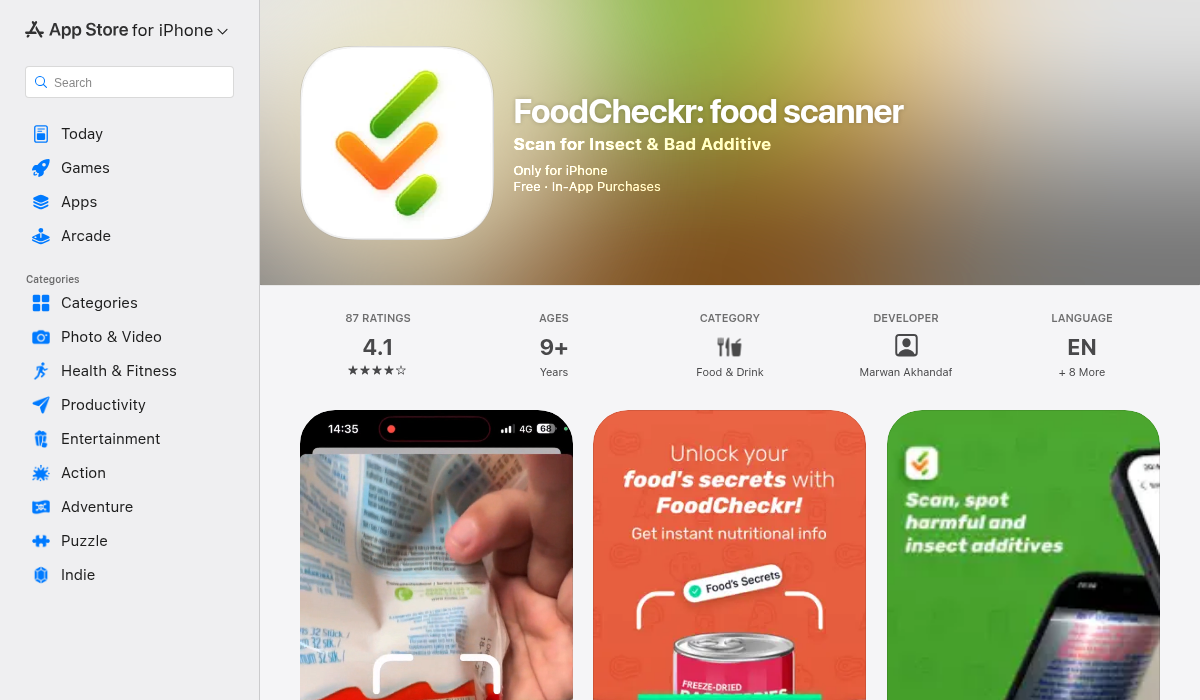
FoodCheckr takes a different approach — it specifically focuses on what many apps miss: harmful additives and insect-derived ingredients. The AI-powered analysis can detect bioengineered ingredients and insect traces that other scanners overlook.
- ✅ Specialized additive detection with risk ratings
- ✅ AI detection for insect-derived and GMO ingredients
- ✅ Privacy-focused (no data collection)
- ✅ Clear red/yellow/green warnings for each additive
- ✅ Affordable ($3.99/month or $17.99/year)
What sets FoodCheckr apart is its additive-first approach. Instead of a general "health score," it breaks down exactly what each E-number means and why it might be concerning — with insect detection being a standout feature for halal, kosher, vegan, and vegetarian users.
Pro Tips for Cleaner Eating
- Shop the perimeter — Fresh produce, meat, and dairy contain fewer additives than packaged foods in center aisles.
- Fewer ingredients = generally safer — A product with 5 ingredients you recognize beats one with 25 you can't pronounce.
- Don't trust "natural" labels — The term is largely unregulated. Carmine (crushed beetles) is technically "natural."
- Check beverages carefully — Drinks often contain more additives than you'd expect, especially sports drinks and flavored waters.
- Scan before you buy — Taking 5 seconds to scan a barcode can reveal concerning ingredients you'd never catch otherwise.
The Bottom Line
Not every additive is harmful, and a single exposure won't hurt you. The concern is cumulative exposure over years from multiple sources. With the FDA finally taking action on synthetic dyes, it's clear that even regulators are acknowledging some additives deserve more scrutiny.
The good news? You don't need to become a food scientist to eat cleaner. Start by being aware of the most concerning additives, and use tools to decode the ones that slip past your radar. Your grocery cart might look a little different — but your body will thank you.
If you want to know exactly what's in your food without memorizing E-numbers, FoodCheckr is worth a look — especially if you're avoiding insect-derived ingredients or GMOs.