
De-Puffing Exercises That Actually Work: A Complete Guide for 2026
You wake up, look in the mirror, and barely recognize yourself—puffy eyes, swollen cheeks, and a jawline that's completely disappeared overnight. Sound familiar? You're not alone. Facial puffiness is one of the most common beauty complaints, and it can make you look tired, older, and unhealthy even when you feel fine.
The good news? There are de-puffing exercises and techniques that actually work—backed by real results and thousands of people who've transformed their morning routine. In this guide, we'll break down the most effective methods for reducing facial bloating, from ancient techniques to AI-powered apps that track your progress.
Why Does Your Face Get Puffy in the First Place?
Before diving into solutions, it helps to understand the problem. Facial puffiness typically happens when fluid builds up in your facial tissues. Common culprits include:
- Excess sodium intake — That late-night pizza or soy sauce-heavy dinner can cause water retention
- Alcohol consumption — Alcohol dehydrates your body while causing inflammation
- Poor sleep — Lying flat for extended periods allows fluid to pool in your face
- Allergies and sinus issues — Inflammation from allergic reactions shows up as puffiness
- Hormonal changes — Menstrual cycles, pregnancy, and stress hormones all play a role
- Lack of movement — Your lymphatic system needs muscle contractions to function properly
The lymphatic system is key here. Unlike your blood circulation (which has your heart pumping it along), lymphatic fluid relies on muscle movement and massage to drain properly. When it stagnates, you get that puffy, swollen look.
What Real People Are Saying
"I've done face massaging/facial yoga to help depuff my face, as well as jaw exercises to tighten the skin around my jaw and thus create a sharper jawline."— Reddit user in r/QOVESStudio
"Refrigerated stainless steel roller balls and facial massage/stainless steel gua sha. Look up facial lymphatic drainage techniques. Also I've noticed popping an antihistamine really helps too on bad days."— Reddit user in r/SkincareAddiction
"Gua sha routines are really helpful for depuffing in the morning."— Reddit user in r/MakeupAddiction
The consensus across skincare communities is clear: consistent facial massage and lymphatic drainage techniques deliver visible results. But knowing what to do and actually doing it correctly are two different things.
De-Puffing Exercises That Actually Work
1. Lymphatic Drainage Massage
This is the gold standard for de-puffing. Lymphatic drainage massage involves gentle, sweeping movements that encourage fluid to move away from your face and toward your lymph nodes (located at your neck and ears).
Basic technique:
- Start at your neck—stroke downward to "open" the drainage pathway
- Use light pressure (think "feather touch")—the lymphatic vessels are superficial
- Move from the center of your face outward, then down
- Always end strokes toward your ears or jawline
- Repeat each movement 3-5 times
The key mistake people make? Using too much pressure. Lymphatic massage should feel gentle—almost ticklish. Heavy pressure actually compresses the vessels and prevents drainage.
2. Gua Sha Technique
Gua sha has been used in traditional Chinese medicine for centuries, and it's experiencing a major revival for good reason. The flat stone tool allows you to apply consistent, gliding pressure across your face.
Morning gua sha routine:
- Apply facial oil or serum (the tool needs to glide, not drag)
- Hold the tool at a 15-degree angle against your skin
- Start at your neck, scraping upward toward your jaw
- Move to your jaw, scraping from chin to ear
- Cheeks: from nose toward temples
- Under-eye: from inner corner outward (very gently)
- Forehead: from center toward hairline
Pro tip: Keep your gua sha tool in the refrigerator. The cold temperature constricts blood vessels and reduces inflammation, amplifying the de-puffing effect.
3. Facial Yoga Exercises
Yes, exercising your face sounds weird—but it works. These movements increase blood flow, tone facial muscles, and encourage lymphatic drainage.
The "Lion Face":
- Open your mouth wide and stick out your tongue
- Stretch your tongue toward your chin
- Widen your eyes and look up
- Hold for 10 seconds, then relax
- Repeat 5 times
Cheek Lifts:
- Smile as wide as possible with lips closed
- Push your cheeks up toward your eyes
- Place your fingers on the outer corners of your eyes to feel the lift
- Hold for 10 seconds
- Repeat 10 times
Jaw Release:
- Open your mouth and move your jaw in a chewing motion
- Hum while doing this to create vibration
- After 20 seconds, open your mouth wide and press your tongue to the bottom of your mouth
- Hold for 5 seconds
- Repeat 3 times
4. Cold Therapy
Cold constricts blood vessels and reduces inflammation almost instantly. Options include:
- Ice globes — Glass or stainless steel spheres you roll across your face
- Frozen spoons — The budget-friendly classic
- Cold water splash — Simple but effective
- Ice facials — Rubbing an ice cube (wrapped in cloth) across your face
For best results, combine cold therapy with massage. Start with cold to reduce inflammation, then follow up with lymphatic drainage movements.
Best Apps for Guided De-Puffing
Let's be honest—knowing these techniques exists and actually doing them correctly every day are two different things. That's where apps come in. They provide guided routines, track your progress, and keep you accountable.
Luvly – Face Yoga Exercises

Luvly is one of the most popular face yoga apps, offering guided video exercises for various concerns. It's been around for several years and has built a solid library of routines.
- ✅ Extensive exercise library
- ✅ Video demonstrations
- ❌ Generic recommendations (not personalized)
- ❌ No way to measure if exercises are actually working
- ❌ Subscription can be pricey for what you get
Bloat Down – Debloat Face
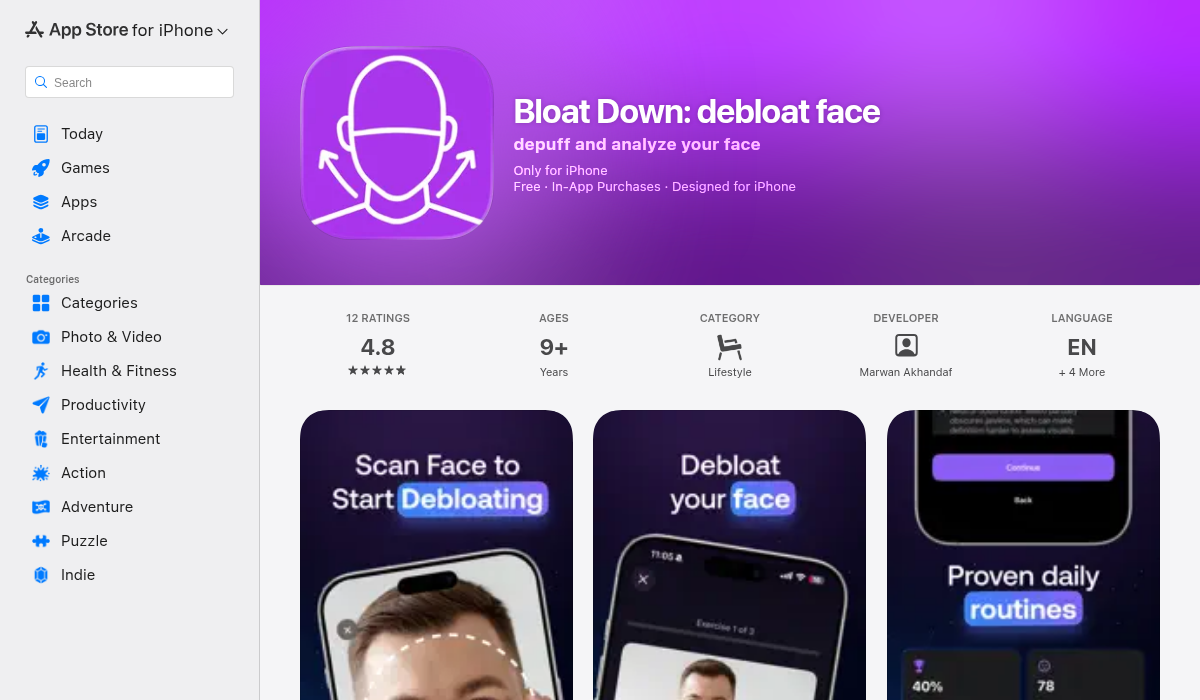
Bloat Down takes a fundamentally different approach. Instead of just showing you exercises and hoping for the best, it uses AI to actually analyze your facial puffiness and track changes over time.
How it works:
- Take a quick facial photo using the guided camera
- AI analyzes puffiness across multiple zones (eyes, cheeks, jawline)
- Get a detailed bloating score and symmetry metrics
- Receive personalized exercise recommendations
- Track your progress with before/after comparisons
What sets Bloat Down apart is the feedback loop. You're not just blindly doing exercises—you can actually see if they're working. The app tracks changes in your facial appearance over time, correlating them with factors like hydration, sleep, and stress.
- ✅ AI-powered facial analysis
- ✅ Personalized recommendations based on your unique face
- ✅ Progress tracking with visual charts
- ✅ Guided exercise routines with video demonstrations
- ✅ Achievement system for motivation
- ✅ Available in 5 languages
- ✅ Affordable premium at $3.99/month
The morning debloat protocols are particularly effective—designed to be done right after waking when puffiness is at its worst. There are also evening sculpting sessions and quick "office reset" routines for when you need to look your best fast.
Pro Tips for Maximum De-Puffing Results
- Consistency beats intensity — 5 minutes every morning beats 30 minutes once a week. Your lymphatic system responds to regular, gentle stimulation.
- Sleep elevated — Adding an extra pillow or using a wedge pillow helps fluid drain from your face overnight.
- Cut sodium after 6 PM — Late-night sodium is the biggest culprit for morning puffiness.
- Hydrate strategically — Drink most of your water earlier in the day. Chugging water before bed can actually increase morning puffiness.
- Move your body — Even a short walk in the morning gets your lymphatic system flowing throughout your entire body.
- Track what works — Everyone's face responds differently. Using an app like Bloat Down to measure changes helps you identify what actually works for you.
The Bottom Line
Facial puffiness isn't something you just have to accept. With the right combination of lymphatic drainage massage, facial exercises, cold therapy, and lifestyle adjustments, you can see dramatic improvements in how your face looks—especially in the morning.
The key is consistency and actually measuring your results. It's easy to think something isn't working when you see your face every day and can't notice gradual changes. That's why tracking tools are so valuable—they show you the improvements you might otherwise miss.
If you're serious about reducing facial bloating and want a data-driven approach, Bloat Down is worth checking out. The AI analysis takes the guesswork out of de-puffing, showing you exactly where you're puffy and tracking your progress over time. At $3.99/month for premium (or free to try), it's a small investment for visible results.
Start tomorrow morning. Take a photo, do a 5-minute lymphatic drainage routine, and track what happens. Your jawline will thank you.