How to Read Faster: Science-Backed Methods That Actually Work
The average person reads 200-400 words per minute. Speed reading courses promise 1,000-1,700 WPM. What does the science actually say works?
Here's the uncomfortable truth most speed reading programs won't tell you: many of their claims don't hold up under scientific scrutiny. A major study published in Psychological Science found that most "speed reading" is actually just effective skimming. But that doesn't mean you can't legitimately improve your reading speed—it just means you need to know what actually works.
The Problem: Too Much to Read, Too Little Time
Students drowning in textbooks. Professionals buried in reports. Anyone trying to stay informed in a world that produces more content than any human could ever consume. The desire to read faster isn't about bragging rights—it's about survival.
"I want to learn how to read faster, while still remembering what I'm reading."— Reddit user in r/IWantToLearn
That "while still remembering" part is crucial. Reading faster is useless if you retain nothing. The goal isn't just speed—it's speed with comprehension.
What Science Says About Speed Reading
Researchers from the Association for Psychological Science reviewed decades of speed reading studies and found some surprising results:
- ❌ Eliminating subvocalization (inner speech) — Doesn't work. Your inner voice actually aids comprehension
- ❌ Reading multiple lines at once — Human visual acuity doesn't support this
- ❌ Peripheral reading — We can only recognize words in a small window around our focus point
- ✅ Skimming — Works, but only for familiar topics where you already have context
- ✅ Practiced reading — Reading more does make you faster at reading
"The most effective 'speed readers' are actually effective skimmers who already have considerable familiarity with the topic at hand."— Association for Psychological Science
This explains why you can skim a news article in 30 seconds but need to slowly read a technical paper in an unfamiliar field.
Techniques That Actually Work
1. The Pointer Method (Meta-Guiding)
Using a finger, pen, or pointer to guide your eyes across text is one of the oldest and most effective techniques. It's not magic—it simply prevents regression (your eyes jumping back to re-read words).
"You can 'push' your eyes faster across a line by using a pointer (pencil, pen, etc.) and pointing it under the word you're reading. Move the pointer at your normal reading speed."— Reddit user in r/books
Start at your normal pace, then gradually increase the pointer speed. Your eyes will naturally try to keep up.
2. Chunking (Reading Word Groups)
Instead of reading word by word, train yourself to read in phrases. Your brain processes meaning in chunks anyway—this just makes the process more efficient.
Instead of:
The → quick → brown → fox → jumped
Try:
"The quick brown" → "fox jumped"
This takes practice, but it can significantly reduce reading time without sacrificing comprehension.
3. RSVP (Rapid Serial Visual Presentation)
RSVP apps display one word at a time at a speed you set. This eliminates eye movement entirely—your eyes stay fixed while words appear in the center of your vision.
"Spreeder is what you're looking for. You copy and paste a block of text, and it shows the passage one word at a time at a speed you set. The idea is that the words are displayed faster than your inner monologue can 'say' the words."— Reddit user in r/IWantToLearn
While research shows RSVP doesn't magically triple your reading speed with full comprehension, it can be useful for certain types of content and as a training tool.
4. Bionic Reading
A newer approach that bolds the first few letters of each word, guiding your eyes to anchor points. Your brain fills in the rest. This method has gained popularity because it doesn't require you to change how you read—the text changes instead.
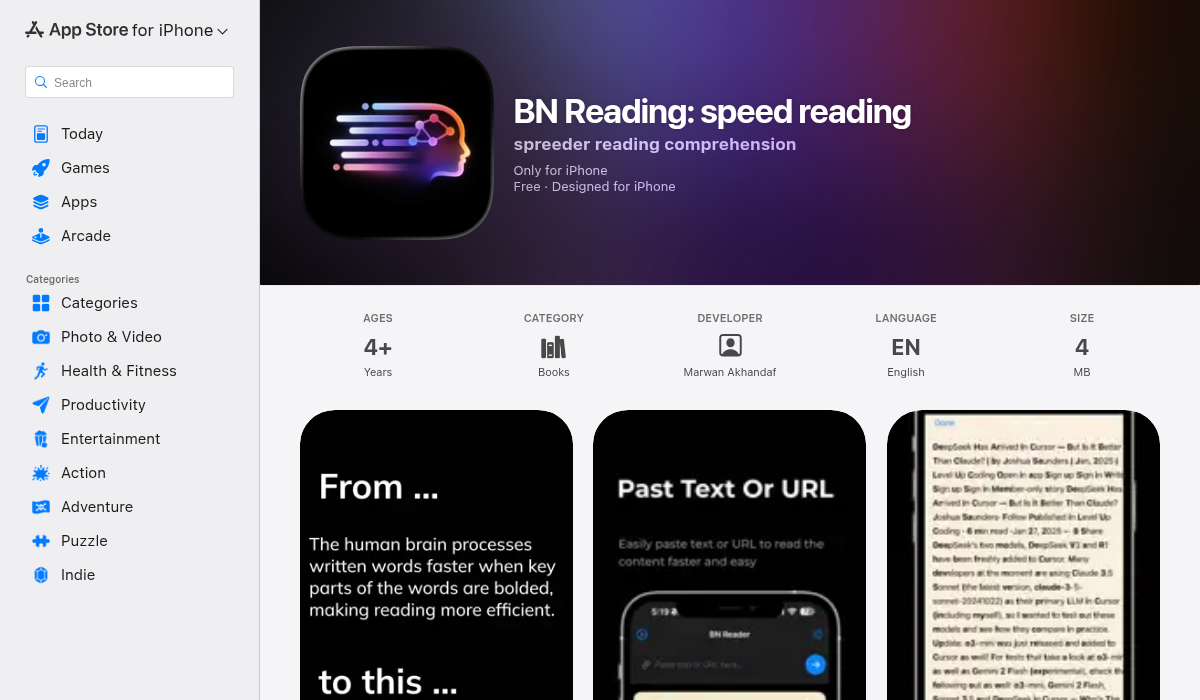
BN Reading uses this bionic reading style with customizable bold intensity. You can adjust how much of each word gets highlighted, import your own text files, and read in a distraction-free environment.
- ✅ Adjustable bold intensity — Find your sweet spot
- ✅ Custom fonts and themes — Reduce eye strain
- ✅ Text file import — Read your documents, articles, books
- ✅ Bookmarks and search — Pick up where you left off
5. Strategic Pre-Reading
Before diving into a text, spend 2-3 minutes on:
- Headings and subheadings — Create a mental map
- First and last paragraphs — Usually contain the main argument
- Bold text and callouts — Authors highlight what they think is important
This isn't cheating—it's priming your brain to process information more efficiently when you do the full read.
The Audio Alternative
Here's a method that's technically not "reading" but achieves the same goal: listening at increased speed.
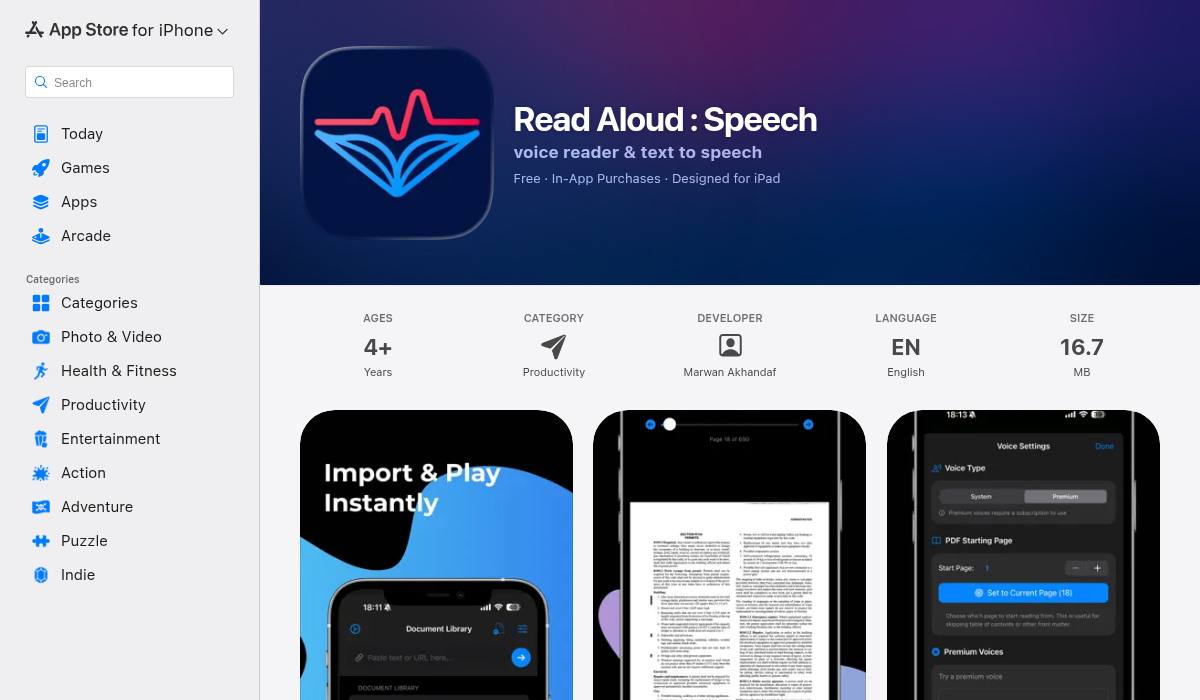
Read Aloud converts any text to speech, letting you consume content while commuting, exercising, or doing chores. The key feature: adjustable speed.
- ✅ Import anything — Plain text, web articles, PDFs
- ✅ Realistic voices — System and premium options
- ✅ Speed control — Start at 1x, work up to 1.5x or 2x
- ✅ Highlighted text — Follow along visually while listening
"Listening to audiobooks to increase playback speed is a very simple and effective way to read faster."— Reddit user in r/speedreading
Most people can comfortably listen at 1.5x-2x speed with full comprehension—effectively doubling their "reading" rate.
Training Your Reading Speed: A Practical Plan
Here's a 4-week approach to genuinely improve your reading speed:
Week 1: Baseline and Pointer Practice
- Measure your current WPM (many apps and websites can do this)
- Practice reading with a pointer for 20 minutes daily
- Don't try to go faster yet—just eliminate regression
Week 2: Push Your Pace
- Time yourself and try to beat your previous speed by 10%
- Accept slightly lower comprehension during training sessions
- Test comprehension afterwards—aim for 70%+ retention
"Time yourself sometime (for X words or X pages). Then try to read again a bit faster and time it. So trying to challenge yourself to read a bit faster than you normally do, until that becomes your normal reading speed."— Reddit user in r/languagelearning
Week 3: Chunking Practice
- Consciously try to read 2-3 words at a time
- Use texts you're already familiar with to reduce cognitive load
- Gradually expand your "chunk" size
Week 4: Integration
- Combine techniques: pre-reading + pointer + chunking
- Test with new, unfamiliar material
- Measure your new baseline WPM
Realistic expectation: 25-50% improvement over your baseline. Not the 5x claims of some programs, but meaningful progress that lasts.
Matching Technique to Content Type
Different content deserves different approaches:
- 📰 News/current events — Skim headers, read first paragraphs, done
- 📚 Textbooks — Pre-read structure, then careful reading with pointer
- 📄 Research papers — Abstract → conclusion → methods (only if needed)
- 📖 Fiction — Don't optimize—enjoyment matters more than speed
- 📋 Reports/documentation — RSVP or text-to-speech while multitasking
The Honest Truth
You probably won't triple your reading speed. But you can realistically:
- Eliminate bad habits (regression, subvocalization for easy content)
- Learn when to skim vs. when to read carefully
- Use technology to consume content more efficiently
- Train your baseline speed up by 25-50%
Combined, these improvements can make a real difference in how much you can read without burning more time.
The Bottom Line
Speed reading isn't a superpower—it's a collection of techniques that work better or worse depending on the situation. The key is knowing which tool to use when.
For daily reading practice, apps like BN Reading can help train your eyes to move more efficiently. For consuming content on the go, Read Aloud turns any text into audio you can speed up.
Start with the pointer method, measure your progress, and build from there. Reading faster isn't about magic tricks—it's about deliberate practice and the right tools.