
How to Scan Food Labels for Vegan Ingredients
Standing in the grocery aisle, squinting at a tiny ingredients list, trying to figure out if "natural flavors" means crushed beetles — we've all been there.
Going vegan sounds simple in theory: avoid animal products. But anyone who's actually tried it knows the reality is far more complicated. Food manufacturers have mastered the art of hiding animal-derived ingredients behind scientific names, E-numbers, and vague descriptions that would confuse even a chemistry PhD. The good news? Technology has finally caught up, and scanning food labels for vegan ingredients has never been easier.
In this guide, we'll break down exactly how to quickly check if a product is vegan — without spending twenty minutes Googling every unfamiliar ingredient. Whether you're a new vegan, transitioning to a plant-based diet, or just trying to make more conscious choices, these tools and techniques will save you serious time at the store.
Why Reading Labels Isn't Enough Anymore
If you've been vegan for more than a week, you've probably discovered that "checking ingredients" is easier said than done. The problem isn't your reading comprehension — it's the deliberate complexity of modern food labeling.
"I thought I was doing everything right until I found out the bread I'd been eating for months contained L-cysteine from duck feathers. Who even thinks to check bread?"— Reddit user in r/vegan
This frustration is universal among vegans. Here's why label-reading alone fails:
- Hidden animal ingredients — Gelatin, carmine, casein, and whey are just the obvious ones. What about glycerin? Mono and diglycerides? Natural flavors? These can all be animal-derived, and there's often no way to tell from the label.
- E-numbers and scientific names — E120 sounds harmless until you learn it's carmine (crushed beetles). E904 is shellac (beetle secretions). E901 is beeswax. Good luck memorizing all of these.
- Cross-contamination warnings — "May contain traces of milk" — does this mean the product itself isn't vegan, or just manufactured in a shared facility? The distinction matters to different people.
- Regional variations — The same product can have different ingredients in different countries. That UK snack that was vegan? The US version might not be.
The reality is that food manufacturers aren't required to clearly label products as "vegan" in most countries. Unless a product carries an official vegan certification — which costs money, so many small brands skip it — you're left playing detective with every purchase.
The Most Commonly Hidden Non-Vegan Ingredients
Before we get into the scanning solutions, let's arm you with knowledge. These are the sneaky animal-derived ingredients that trip up even experienced vegans:
Always Non-Vegan
- Gelatin — Made from boiling animal bones, skin, and ligaments. Found in gummy candies, marshmallows, some yogurts, and countless medications.
- Carmine / Cochineal / E120 — Red dye made from crushed cochineal beetles. Used in red candies, fruit drinks, cosmetics, and even some yogurts.
- Casein / Caseinate — Milk protein often added to "non-dairy" products like coffee creamers and cheese alternatives.
- Whey — Milk byproduct found in protein bars, bread, crackers, and countless processed foods.
- Shellac / E904 / Confectioner's Glaze — Secretion from lac beetles used to make candies and fruit shiny.
- Isinglass — Fish bladder used to filter wine and beer. Not listed on the bottle.
- Lanolin — Grease from sheep wool, common in vitamin D supplements and skincare.
Sometimes Animal-Derived (Check the Source)
- Vitamin D3 — Usually from sheep wool lanolin or fish. Vegan versions from lichen exist but are less common.
- Omega-3 — Typically from fish. Look for algae-based omega-3 for vegan options.
- L-Cysteine / E920 — Amino acid that can come from duck feathers or human hair. Used as a dough conditioner in bread.
- Glycerin / Glycerol / E422 — Can be plant-based or from animal fat. No way to tell from the label.
- Mono and Diglycerides / E471 — Emulsifiers that can be from plant or animal sources.
- Stearic Acid — Found in chocolate and soap; can be from animal fat or plant sources.
- Lecithin / E322 — Usually from soy or sunflower, occasionally from eggs.
- Natural Flavors — The vaguest term in food labeling. Could be anything from plant extracts to beaver glands (castoreum).
- Sugar — Some white sugar is filtered through bone char. Most brown sugar and organic sugar are vegan.
Memorizing all of this is unrealistic. That's exactly why ingredient scanning apps exist.
How Vegan Scanner Apps Actually Work
Vegan scanning apps use two main approaches to help you identify non-vegan ingredients:
Barcode Scanning
The most common method. You scan a product's barcode, and the app looks it up in a database to show you whether it's vegan. This works great for popular products in major markets, but has limitations:
- New products may not be in the database yet
- Store-brand or local products often missing
- Formulations change, databases lag behind
Ingredient Scanning (OCR + AI)
The newer, more powerful approach. Instead of relying on barcodes, these apps let you photograph the actual ingredients list. AI-powered optical character recognition (OCR) reads the text and analyzes each ingredient against a database of known vegan/non-vegan items.
This method works on ANY product — no database required. Even that obscure import from the ethnic foods aisle can be checked instantly.
Best Vegan Scanning Apps in 2026
After testing the most popular options, here's what actually works:
1. VeganCheckr
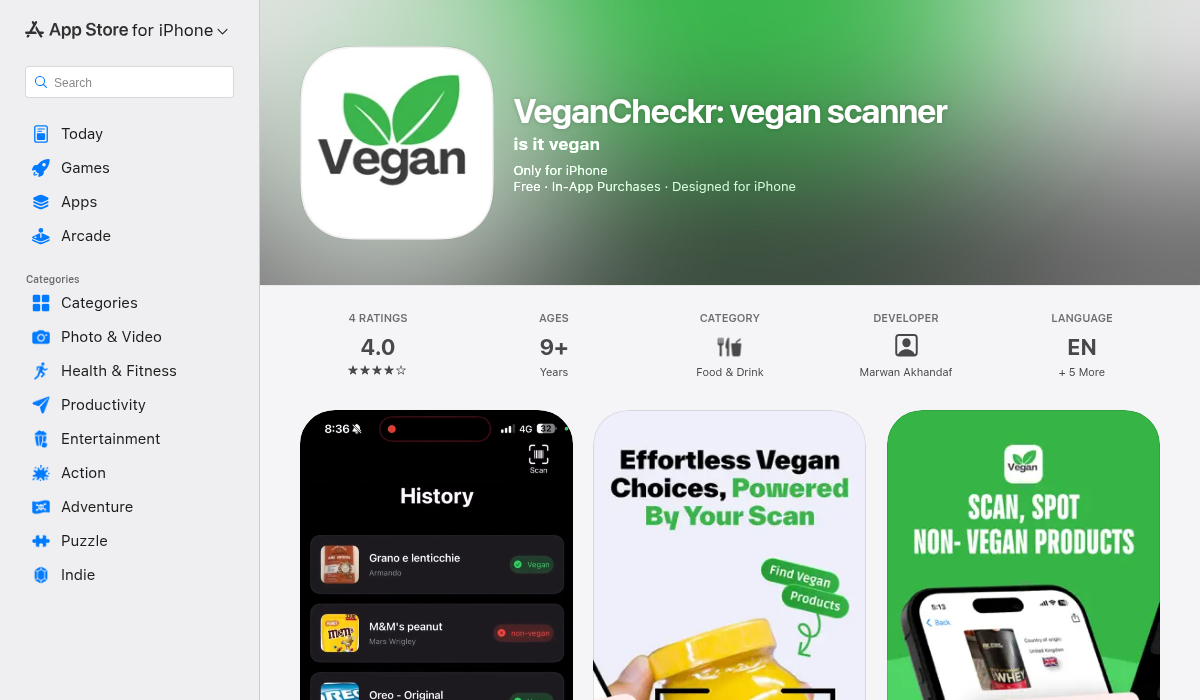
VeganCheckr stands out by offering both barcode scanning AND direct ingredient scanning. This dual approach solves the "not in database" problem that plagues most vegan apps.
Key features:
- ✅ Barcode scanner with detailed ingredient breakdowns
- ✅ Ingredient text scanning — snap a photo of any ingredients list
- ✅ Additive checker — look up any E-number or suspicious ingredient
- ✅ Vegan Map — find vegan-friendly restaurants and stores nearby
- ✅ Product comparison — compare multiple products side-by-side
- ✅ Community reporting — flag incorrect product info
Classification system:
- ✅ Green — Confirmed vegan, no animal products
- ⚠️ Orange — May contain animal ingredients, needs verification
- ❌ Red — Contains animal-derived ingredients
Pricing: Free with limited features. Premium plans from $0.99/week or $12.99/year for unlimited scans.
What we like most is the flexibility. Barcode databases are great when they work, but having the fallback of direct ingredient scanning means you're never stuck squinting at a label trying to remember what E471 is.
2. WhatsVegan
Another solid ingredient scanner that focuses exclusively on photographing ingredients lists rather than barcode scanning. The AI marks each ingredient with color-coded rectangles showing whether it's plant-based, animal-based, or uncertain.
- ✅ Works on any product worldwide
- ✅ Detailed ingredient explanations
- ❌ No barcode scanning option
- ❌ Higher price point ($29.99/year)
3. Veganify / Is It Vegan
Open-source option built on the Open Food Facts database. Free and community-driven, but the database coverage can be spotty depending on your region.
- ✅ Completely free and open-source
- ✅ Large database of products
- ❌ No ingredient text scanning
- ❌ Missing many local/regional products
Pro Tips for Faster Vegan Shopping
Beyond apps, here are strategies that experienced vegans use to speed up their grocery trips:
- Learn the obvious red flags first — Gelatin, casein, whey, and carmine catch 90% of problems. Once you can spot these instantly, you'll rarely need to scan.
- Look for official certifications — The Vegan Society sunflower logo, Certified Vegan logo, or BeVeg certification mean a product has been verified. No scanning needed.
- Shop the perimeter — Fresh produce, frozen vegetables, beans, rice, bread (check for L-cysteine) — the less processed, the less likely to contain hidden animal ingredients.
- Build a "safe list" — Once you've verified a product, you don't need to scan it again. Most vegan apps let you save favorites.
- Check before you go — Looking for a specific snack or wine? Search online or in your app at home, not in the store aisle.
- When in doubt, skip it — If the ingredients list reads like a chemistry textbook and you don't have your phone, just put it back. There's always a cleaner alternative.
What About Wine, Beer, and Cosmetics?
Food labels are one thing, but some non-vegan products don't even list their animal-derived processing aids:
Wine and Beer: Many wines and beers use isinglass (fish bladder), gelatin, or egg whites to filter out sediment. These aren't listed on the bottle. Use Barnivore.com or check your vegan app's alcohol database.
Cosmetics: Look for carmine (red pigments), beeswax, lanolin, and keratin. Many vegan apps now include cosmetics scanning, or use dedicated apps like Think Dirty or Yuka.
Medications: Gelatin capsules are extremely common. Ask your pharmacist about alternatives or look for plant-based capsule versions.
The Bottom Line
Scanning food labels for vegan ingredients doesn't have to be a twenty-minute ordeal anymore. The combination of barcode databases and AI-powered ingredient scanning means you can verify any product in seconds — even obscure imports that traditional apps would miss.
For most shoppers, we'd recommend an app that offers both scanning methods. You get the convenience of instant barcode lookups for common products, plus the flexibility to photograph any ingredients list when the barcode fails.
The vegan learning curve is real, but it gets easier. After a few weeks of scanning, you'll start recognizing problem ingredients on sight. Until then, let your phone do the heavy lifting.
If you're looking for a reliable vegan scanner that works on any product, VeganCheckr is worth checking out — the combination of barcode scanning, ingredient text analysis, and the built-in vegan map makes it one of the more complete options available.