
Insect Ingredients in Food: What to Watch For
That vibrant red candy you're eating might contain crushed beetles — and you'd never know it just by reading the label.
Insect-derived ingredients are more common in everyday foods than most people realize. From the red coloring in your favorite yogurt to the shiny coating on your hard candies, insects play a surprisingly large role in the food industry. Whether you're vegan, follow religious dietary laws, or simply prefer to know exactly what's going into your body, understanding these hidden ingredients is becoming increasingly important in 2026.
The Hidden Insects in Your Grocery Cart
When most people think of "eating bugs," they picture trendy cricket protein bars or mealworm snacks being marketed as sustainable protein sources. But the reality is far more subtle — and far more widespread. Insect-derived ingredients have been in our food supply for decades, often hidden behind cryptic E-numbers and scientific-sounding names.
The food industry uses insects primarily for two purposes: coloring and coating. And unless you know exactly what to look for, these ingredients can slip past even the most careful label readers.
"I always check for carmine, carminic acid, cochineal, E120, and shellac. They're all insect-derived ingredients."— Reddit user in r/vegan
This comment highlights a frustrating reality: you need to memorize multiple names for the same ingredient just to avoid it. Let's break down exactly what these ingredients are and where they're hiding.
The Most Common Insect Ingredients to Watch For
1. Carmine (E120) — The Beetle Red
Carmine is perhaps the most widely used insect-derived ingredient in the food industry. Also known as cochineal extract, cochineal, carminic acid, or Natural Red 4, this deep red dye comes from crushed cochineal beetles — small insects that live on cacti in Central and South America.
It takes approximately 70,000 beetles to produce just one pound of carmine dye. The beetles are collected, dried, and crushed to extract the carminic acid that creates that characteristic red color.
Where you'll find E120:
- Red and pink candies
- Strawberry and raspberry flavored yogurts
- Fruit juices and smoothies
- Ice cream with red or pink coloring
- Some red meat products (to enhance color)
- Cosmetics like lipstick and blush
2. Shellac (E904) — The Shiny Secret
Ever wonder why some candies have that perfect glossy shine? There's a good chance it's shellac — a resin secreted by the female lac beetle. These insects coat tree branches with their secretion, which is then harvested, processed, and used as a glazing agent.
Shellac is also commonly called "confectioner's glaze" or "resinous glaze" on ingredient labels — names that give no indication of its insect origin.
Where you'll find shellac:
- Shiny hard candies (including jelly beans)
- Chocolate-coated candies
- Fresh fruit coatings (to extend shelf life)
- Pharmaceutical pill coatings
- Some coffee beans (for shine)
"Hard candy is often coated with shellac, a resin-like byproduct of the lac insect. I had no idea until I started reading ingredient labels more carefully."— Reddit user in r/todayilearned
3. Beeswax (E901) — The Gray Area
Beeswax is another insect-derived ingredient, though it sits in a gray area for many people. While it doesn't require killing bees to harvest, it's still an animal byproduct that some dietary lifestyles avoid. It's commonly used as a glazing agent and to prevent ingredients from sticking together.
Where you'll find beeswax:
- Candy coatings
- Chewing gum
- Fresh produce coatings
- Some cheese rinds
Why This Matters More in 2026
The concern about insect ingredients isn't new, but awareness has exploded in recent years. Several factors are driving this increased attention:
Religious dietary laws: Both Islamic halal guidelines and Jewish kosher laws have specific rulings about insect consumption. Many scholars consider insects haram (forbidden) or non-kosher, making these hidden ingredients a significant concern for observant individuals.
Vegan lifestyle growth: As plant-based eating continues to grow, more people are scrutinizing labels for any animal-derived ingredients — including those from insects.
Allergy concerns: Some people experience allergic reactions to carmine, particularly those with shellfish allergies. The FDA now requires carmine to be listed by name on labels (rather than just "artificial color"), but it can still be easy to miss.
New EU regulations: The European Union has been approving various insects for human consumption, leading to increased labeling requirements and consumer awareness about what's already been in food for years.
How to Identify Insect Ingredients on Labels
Here's your cheat sheet for spotting insect-derived ingredients:
| Ingredient Name | E-Number | Source | Used For |
|---|---|---|---|
| Carmine, Cochineal, Natural Red 4 | E120 | Cochineal beetles | Red coloring |
| Shellac, Confectioner's Glaze | E904 | Lac beetle secretion | Shiny coating |
| Beeswax | E901 | Honeybee secretion | Glazing, coating |
| Lac dye, Lac resin | E120/E904 | Lac beetle | Red coloring, glazing |
The challenge is that these ingredients appear under different names across different countries and products. Even experienced label readers can miss them, especially when shopping quickly or dealing with unfamiliar brands.
Apps That Can Help You Scan for Insect Ingredients
Given the complexity of ingredient labels, technology has become an invaluable tool for identifying hidden insect ingredients. Let's look at the options available in 2026.
1. Yuka — General Health Scanner

Yuka is one of the most popular food scanning apps, with millions of users worldwide. It provides an overall health score for products based on nutritional content and additives.
- ✅ Large database of products
- ✅ Clear health scores
- ✅ Will flag E120 and E904 as additives
- ❌ Doesn't specifically highlight insect origins
- ❌ Focuses on general health rather than dietary restrictions
Yuka is solid for overall health-conscious shopping, but if insect ingredients are your primary concern, you might want something more specialized.
2. FoodCheckr — Specialized Insect Detection
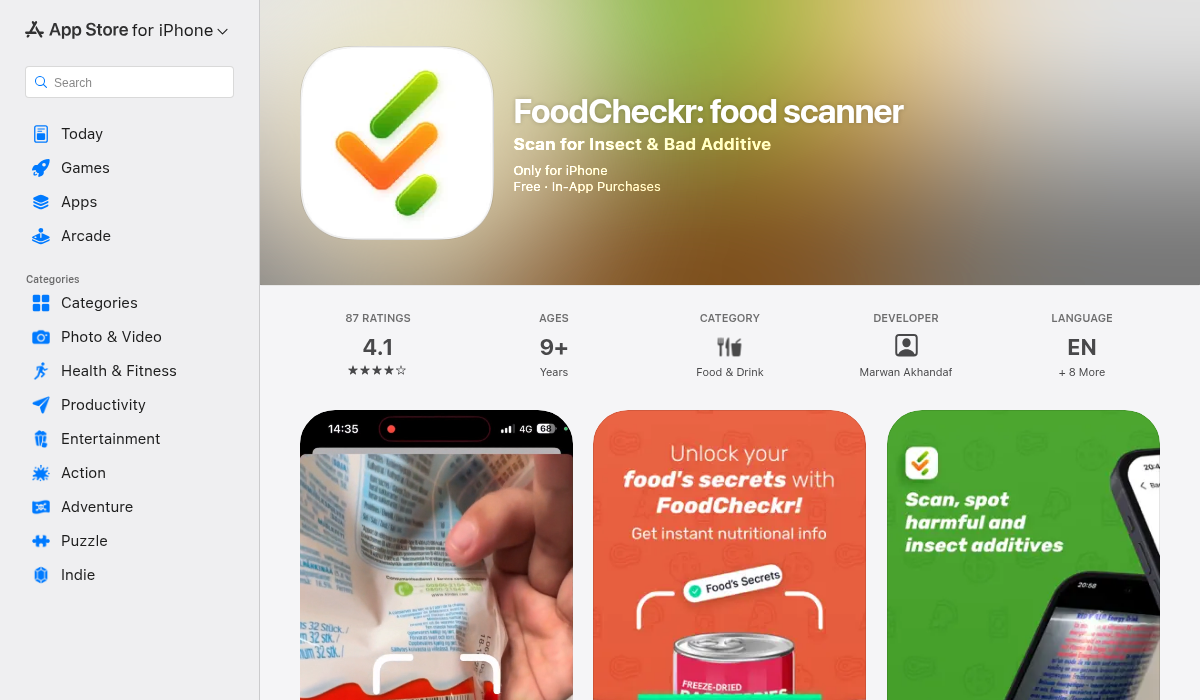
FoodCheckr takes a different approach, specifically designed to flag hidden ingredients that many other apps overlook. Its AI-powered analysis includes dedicated insect trace detection — a feature that scans for carmine, shellac, and other insect-derived ingredients automatically.
- ✅ Dedicated insect ingredient detection
- ✅ AI-powered analysis for hidden ingredients
- ✅ Clear risk ratings (green/yellow/red)
- ✅ Flags E120, E904, E901 specifically as insect-derived
- ✅ Bioengineered ingredient detection (bonus for those avoiding GMOs)
- ✅ Privacy-focused — no data collected
What sets FoodCheckr apart is that it doesn't just tell you an ingredient exists — it explains what it is and where it comes from. When you scan a product containing carmine, you'll see a clear warning that it's derived from beetles, not just a generic "additive" flag.
3. Open Food Facts — Community-Driven Database
For the DIY crowd, Open Food Facts offers a free, open-source database of food products. You can search for products and manually check ingredient lists, though it requires more work than app-based scanning.
- ✅ Free and open-source
- ✅ Massive community-contributed database
- ❌ Requires manual ingredient checking
- ❌ Interface can be overwhelming
- ❌ No automated insect ingredient flagging
Pro Tips for Avoiding Insect Ingredients
- Memorize the key E-numbers — E120 (carmine), E904 (shellac), and E901 (beeswax) are your main concerns. Save these to your phone notes for quick reference.
- Watch out for "natural colors" — When a product says "natural red color" or "natural colors," it may contain carmine. The word "natural" doesn't mean plant-based.
- Be suspicious of shiny coatings — If hard candies, fruits, or coffee beans have an unusually glossy appearance, check for shellac or confectioner's glaze.
- Check cosmetics too — Carmine is widely used in lipstick, blush, and eyeshadow. If you're avoiding insect ingredients in food, don't forget your makeup bag.
- Use a dedicated scanner app — Instead of manually checking every label, let an app like FoodCheckr do the heavy lifting. It's especially useful when shopping in a hurry.
- Contact manufacturers directly — When in doubt, reach out to the company. Many are responsive to dietary restriction questions and can confirm whether their products contain insect-derived ingredients.
Common Products That Often Contain Insect Ingredients
Based on our research, here are product categories that frequently contain carmine or shellac:
- Red/pink candies: Gummy bears, jelly beans, licorice
- Dairy products: Strawberry yogurt, raspberry ice cream
- Beverages: Some fruit juices, energy drinks, cocktail mixers
- Baked goods: Red velvet cake mixes, frosting
- Produce: Waxed apples, oranges, lemons
- Supplements: Red-colored vitamin gummies, pills with shiny coatings
The good news is that many brands are reformulating to use plant-based alternatives like beetroot extract, anthocyanins (from berries), or carnauba wax. Look for these on ingredient lists as insect-free alternatives.
The Bottom Line
Insect ingredients are far more prevalent in our food supply than most people realize. From the red coloring in your yogurt (carmine from beetles) to the shiny coating on your candy (shellac from lac beetles), these ingredients hide behind scientific names and E-numbers that give no hint of their origin.
Whether you avoid insects for religious reasons, ethical principles, allergy concerns, or simply personal preference, staying informed is your best defense. Memorizing key ingredient names helps, but in 2026, technology makes it much easier.
If you're serious about avoiding insect-derived ingredients, a scanning app that specifically flags these additives — like FoodCheckr with its dedicated insect trace detection — can save you hours of label reading and give you confidence in your food choices.
The insects aren't going anywhere, but at least now you know what to look for.