
Is Carmine (E120) Halal? The Complete Guide
Carmine (E120) is one of the most confusing ingredients for Muslim shoppers: it appears in candies, yogurts, drinks, and cosmetics, but many labels don’t explain what it actually is. If you’ve ever paused in a store aisle wondering whether to put a product back, this guide gives you the evidence-based answer and a practical way to check products faster.
Short version: carmine is a red colorant derived from insects (cochineal). Many scholars and halal standards classify it as non-halal or at least highly doubtful, while some minority opinions differ. Because of that disagreement, most Muslim shoppers treat E120 as an ingredient to avoid unless a trusted certification body confirms otherwise.
The Problem Everyone’s Facing
Modern ingredient labels are crowded, and E-numbers are hard to interpret in seconds. Even careful shoppers can miss red flags when they are in a rush.
This confusion is visible in Muslim communities online. One Reddit user summarized the everyday strategy many families follow:
“Most are halal. Avoiding anything with gelatine, E120/carmine and you should be fine.”— Reddit user in r/MuslimLounge
That rule-of-thumb is practical, but let’s go deeper and anchor the decision in Islamic sources and scholarly method.
What Islamic Sources Say About Food Purity
The Quran establishes a general principle: Muslims should consume what is lawful (halal) and pure (tayyib).
- Surah Al-Baqarah 2:168 — “Eat from whatever is on earth [that is] lawful and good.”
- Surah Al-Baqarah 2:173 and Surah Al-Ma’idah 5:3 — detail prohibited categories and reinforce caution with doubtful matters.
The Sunnah adds a key principle: lawful and unlawful are clear, and doubtful matters should be avoided. This framework appears in authentic narrations (including Sahih Bukhari, commonly cited as hadith 52/2051 depending on numbering systems, and Sahih Muslim narrations on doubtful matters).
So in practical halal shopping, the process is:
- Identify the ingredient source
- Check recognized scholarly guidance/certification
- Avoid doubtful products when evidence is unclear
What Is Carmine (E120), Exactly?
Carmine (also labeled as cochineal extract, natural red 4, or E120) is a red pigment obtained from cochineal insects. It is widely used for red/pink coloring in processed foods and beverages.
From a halal perspective, the key issue is source origin. Since it is insect-derived, many halal standards and scholars flag it as impermissible or doubtful for mainstream consumers unless explicit certification addresses it in that product context.
Scholarly Difference of Opinion (Ikhtilaf)
This is where nuance matters. You may encounter different rulings online:
- Majority practical consumer guidance: avoid E120/carmine because of insect origin and uncertainty in processing standards.
- Minority views: some scholars/schools discuss permissibility for certain insect derivatives or specific processing pathways.
Because this is an area with real ikhtilaf (scholarly difference), presenting one internet opinion as universal law is inaccurate. For day-to-day shopping, many families follow the safer approach: avoid E120 and choose alternatives with clear halal certification.
What Actually Works in 2026
The best halal shopping workflow now is not memorizing every additive by heart. It is using tools plus a short decision checklist:
- Scan barcode or ingredient list
- Flag E120/carmine instantly
- Check certification source (JAKIM, IFANCA, HMC, local authority)
- If uncertain, choose a cleaner alternative
That approach is faster, more consistent, and easier for families shopping in mixed-product supermarkets.
Best Apps Compared
1. Scan Halal

Scan Halal-style tools focus on quick permissibility checks. They can be useful for fast shopping, especially for users who want a direct yes/no style result.
- ✅ Quick barcode flow
- ✅ Simple for non-technical users
- ❌ Detail depth varies by database quality
2. HalalFoodScan
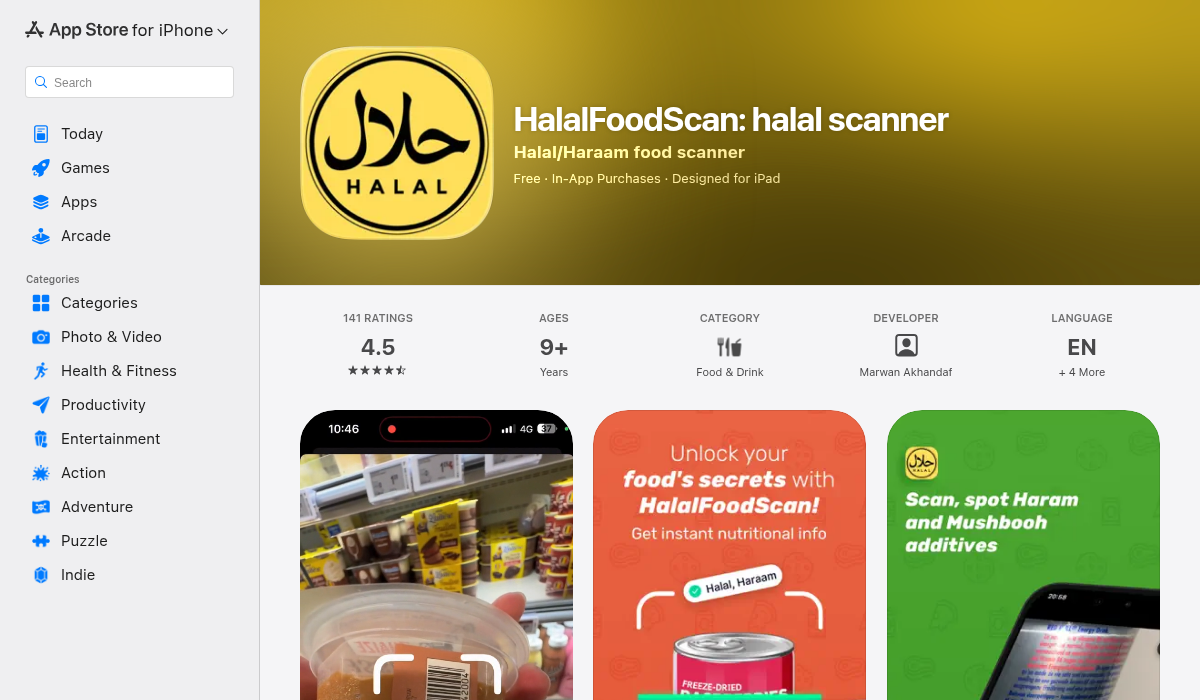
HalalFoodScan is designed for Muslims who want both speed and context: barcode scanning, additive analysis, and clearer category outputs (Halal, Mushbooh, Haram, Unknown). It also helps when products are missing by letting users scan ingredient panels directly for additive detection.
- ✅ Barcode + additive workflow for real store conditions
- ✅ Clear category model (Halal / Mushbooh / Haram / Unknown)
- ✅ Useful for ambiguous E-number situations
- ✅ Built for multilingual Muslim audiences
Carmine (E120) in Real Products: Where It Hides
You’ll most often see E120 in:
- Red/pink candies and gummies
- Flavored yogurts and desserts
- Fruit drinks and syrups
- Decorative food coatings
It can appear under different names, so checking only for “carmine” is not enough. Watch for: E120, cochineal, cochineal extract, and natural red 4.
Practical Halal Decision Tree
- See E120/carmine? → Treat as avoid/doubtful by default.
- Trusted halal certification present? → Verify certifier and scope.
- No clear certification? → Choose an alternative product.
- Still uncertain? → Ask a qualified local scholar/imam with product details.
This method protects your deen while reducing shopping stress. You’re not expected to issue fatwas in a supermarket aisle—you’re expected to act responsibly with the information available.
Pro Tips for Muslim Shoppers
- Memorize a short “watch list” — gelatin, E120, shellac, unclear emulsifiers.
- Favor certified brands — consistency beats constant uncertainty.
- Use scanning tools as first pass — then verify edge cases manually.
- Teach family labels together — especially kids and teens buying snacks.
- Keep a personal safe-products list — your weekly shopping gets faster every month.
How E120 Differs from Other Common Additives
Muslim shoppers often ask: “If E120 is doubtful, what about E322, E471, or E904?” This is a smart question because additives do not share the same ruling category.
- E120 (Carmine): insect-derived source; often treated as avoid/doubtful in mainstream halal shopping practice.
- E322 (Lecithin): frequently soy-based and often halal, but source should still be checked when unclear.
- E471 (Mono- and diglycerides): source-dependent (plant or animal), typically Mushbooh unless verified.
- E904 (Shellac): insect secretion; commonly flagged as doubtful by cautious consumers.
This is exactly why generic “halal ingredient lists” from random social posts can mislead people. A source-aware tool and trusted certification references are safer than memorizing incomplete charts.
Certification Bodies and Why They Matter
Two products can have similar ingredient names but different sourcing and manufacturing chains. Certification closes that gap. When you see a halal logo, check which body issued it and whether it is recognized in your region.
Frequently referenced organizations include JAKIM, IFANCA, HMC, MUI, and local national halal authorities. The practical rule: trusted certifier + clear labeling beats assumptions based on packaging claims.
Real-World Scenarios: What to Do Fast
Scenario 1: Candy with “natural colors” but no details
Treat as uncertain. If there is no clear certification and no ingredient transparency, choose another product.
Scenario 2: Yogurt lists E120 explicitly
Default to avoid unless a reliable certifier validates that exact product SKU and market.
Scenario 3: Product has halal logo, but unknown certifier
Verify the certifier website. Counterfeit or unrecognized logos exist in some markets.
Scenario 4: Family disagreement about permissibility
Use adab and evidence. Present sources, explain ikhtilaf respectfully, and align on a shared household standard. In many homes, following the cautious position prevents conflict and confusion.
FAQ: Carmine (E120) and Halal Shopping
Is all red food coloring haram?
No. Not all red colorants are the same. Carmine/E120 is specifically the insect-derived one that raises halal concern. Other red dyes have separate rulings and safety discussions.
Can a product be vegetarian but not halal?
Yes. Vegetarian labeling does not automatically equal halal compliance. Source, processing, and certification all matter.
What about products imported from non-Muslim countries?
Apply the same method: ingredient check, certifier check, and avoid doubtful items when evidence is missing.
Do I need to memorize every E-number?
No. Memorize a short high-risk list and rely on scanning tools + certification verification for everything else.
A Family-Friendly Halal Shopping Routine
If you shop for a household, consistency matters more than memorizing advanced fiqh debates. A practical family routine is: keep a trusted app ready, maintain a shared “safe brands” note, and review new products once before adding them to regular rotation.
Many families also assign one quick role to each person—one checks certification marks, one checks additives, one checks alternatives—so shopping becomes faster and less stressful. Over time, this creates a household halal standard that protects everyone and reduces decision fatigue.
One-Minute Label Check Before You Buy
When you pick up a new product, do this quick sequence: read the full additive line, search for E120/cochineal/carmine aliases, verify certification, then decide. If any step is unclear, leave it. The easiest halal lifestyle is not finding justifications for doubtful items—it is making clean alternatives your default pattern daily.
The Bottom Line
For most Muslim consumers, the safest practical answer is: treat Carmine (E120) as an ingredient to avoid unless you have clear, trusted halal certification for that specific product. This aligns with caution in doubtful matters and avoids accidental compromise.
If you want faster in-store checks for E-numbers and ambiguous ingredients, HalalFoodScan is worth trying.
Note: For specific religious rulings (fatwa), always consult qualified Islamic scholars or your local imam. This article provides general information based on recognized Islamic sources and common contemporary halal certification practices.
Sources referenced: Quran (2:168, 2:173, 5:3), authentic hadith corpus on lawful/unlawful and doubtful matters, App Store listings, and Muslim community discussions on ingredient screening behavior.