
Is Gelatin Halal? What Muslims Need to Know
You pick up a bag of gummy bears at the store, flip it over, and there it is — "gelatin." Instantly, the question hits: is this halal?
It's one of the most common — and most confusing — questions in the Muslim community. Gelatin is everywhere: in candy, yogurt, marshmallows, capsules, even some ice creams. Yet most people have no idea where it actually comes from or whether it's permissible to consume. The answer isn't as simple as "yes" or "no" — it depends on the source, the processing, and which scholarly opinion you follow.
In this guide, we'll break down exactly what gelatin is, where it comes from, what Islamic scholars say about different types, and how you can easily check if the products you buy are halal.
What Exactly Is Gelatin?
Gelatin is a protein derived from collagen — the connective tissue found in animal skin, bones, and cartilage. Through a process called hydrolysis, collagen is broken down into gelatin, which gives foods that signature jiggly, gummy texture.
Here's where it gets tricky for Muslims: gelatin can come from several sources, and each has a different ruling.
- Pork gelatin — Derived from pig skin and bones. This is the most common type used in Western food manufacturing.
- Bovine (beef) gelatin — Derived from cow hides and bones. Halal status depends on whether the animal was slaughtered according to Islamic guidelines.
- Fish gelatin — Derived from fish skin and bones. Generally considered halal by all scholars.
- Plant-based alternatives — Agar-agar, pectin, and carrageenan. Always halal.
The problem? Most products simply list "gelatin" on the label without specifying the source. And in Europe and North America, the default is overwhelmingly pork-derived.
What Do Islamic Scholars Say?
The ruling on gelatin involves one of the more nuanced discussions in Islamic jurisprudence (fiqh). Let's look at what the Quran, Hadith, and major scholarly bodies have to say.
The Clear Prohibition
The Quran is explicit about pork being forbidden. In Surah Al-Baqarah (2:173), Allah says:
"He has only forbidden to you dead animals, blood, the flesh of swine, and that which has been dedicated to other than Allah."— Quran, Surah Al-Baqarah 2:173
And in Surah Al-Ma'idah (5:3), the prohibited foods are listed in further detail. Based on these verses, pork and its derivatives are clearly haram — but what happens when pork undergoes such extreme chemical transformation that it becomes a completely different substance?
The Istihalah Debate
This is where scholars diverge. Istihalah (استحالة) is the Islamic concept of chemical transformation — when a substance changes so fundamentally that it becomes an entirely new material with different properties.
The classic example is vinegar. The Prophet Muhammad ﷺ said:
"What an excellent condiment vinegar is."— Prophet Muhammad ﷺ (Sahih Muslim 2052)
Wine is haram, but when it transforms into vinegar, it becomes halal. The alcohol converts entirely into acetic acid — a completely different substance. Scholars widely agree on this.
So the question becomes: does gelatin undergo a similar level of transformation from its animal source?
Scholars Who Say Yes — Gelatin Is Halal Through Istihalah
Some contemporary scholars and Islamic bodies argue that gelatin — even from pork — undergoes such complete chemical transformation during hydrolysis that it becomes a new, pure substance. Notable proponents include:
- The former Mufti of Perlis (Malaysia) — Has stated that gelatin or DNA obtained from pigs can be considered halal if it has undergone complete chemical transformation.
- Some Hanafi scholars — The Hanafi school traditionally has the broadest interpretation of istihalah, accepting that complete transformation purifies a substance.
Scholars Who Say No — The Source Still Matters
The majority position among contemporary scholars and certification bodies is that pork gelatin remains haram, because:
- The transformation is not considered complete enough — gelatin retains its protein structure from the original animal.
- JAKIM (Malaysia), MUI (Indonesia), IFANCA (USA), and most halal certification bodies do not certify pork-derived gelatin as halal.
- Scholars like Sheikh Ibn Uthaymeen and Sheikh Ibn Baz held that pork derivatives remain impure regardless of processing.
As one Reddit user put it:
"Some scholars say that even if it is from a haram source it is still halal because of the processing — however the best opinion to follow is that if it is from a haram source then it is impermissible."— Reddit user in r/islam
The Safe Position
The Prophet ﷺ gave us a guiding principle for exactly these situations:
"What is lawful is clear and what is unlawful is clear, and between them are doubtful matters about which many people do not know. So whoever avoids doubtful matters clears himself in regard to his religion and his honor."— Prophet Muhammad ﷺ (Sahih Bukhari 52, Sahih Muslim 1599)
When in doubt, the safest approach is to avoid pork-derived gelatin entirely and choose alternatives that are clearly halal.
Breaking Down Gelatin by Source
Here's a quick reference for the halal status of different gelatin types:
- ✅ Fish gelatin — Halal by consensus. Fish is permissible in Islam without requiring slaughter.
- ✅ Plant-based alternatives (agar-agar, pectin, carrageenan) — Always halal. Derived from seaweed or fruits.
- ⚠️ Bovine (beef) gelatin — Halal only if the cow was slaughtered according to Islamic guidelines (zabiha). Many beef gelatins in Western markets come from non-zabiha sources.
- ❌ Pork gelatin — Haram according to the majority of scholars. Even those who accept istihalah acknowledge it's a minority opinion.
- ⚠️ "Gelatin" (source unspecified) — Treat as mushbooh (doubtful). In Western markets, assume pork unless confirmed otherwise.
Halal Alternatives to Gelatin
The good news? There are excellent plant-based alternatives that work just as well in most applications:
- Agar-agar (E406) — Derived from red seaweed, this is the most popular halal gelatin substitute. It sets firmer than gelatin and works at room temperature. Widely used in Asian cuisine for centuries.
- Pectin — Extracted from fruit peels (usually apples or citrus). Perfect for jams, jellies, and gummy candies. Always halal.
- Carrageenan (E407) — Another seaweed-derived gelling agent, commonly used in dairy alternatives, puddings, and ice cream.
- Konjac (glucomannan) — Derived from the konjac plant. Used in some Asian desserts and increasingly in Western health foods.
Many halal-certified brands now specifically use these alternatives. The halal food market is growing rapidly — projected to reach $2.5 trillion globally — and manufacturers are responding with more clearly-labeled options.
How to Check If a Product Contains Halal Gelatin
Reading labels is essential, but let's be honest — it's not always straightforward. "Gelatin" on a label tells you almost nothing about its source. Here's what you can do:
- Look for halal certification logos — Products certified by IFANCA, JAKIM, HMC, or similar bodies have been verified.
- Check for "bovine gelatin" or "fish gelatin" — Some manufacturers specify the source. If it just says "gelatin," be cautious.
- Contact the manufacturer — Many companies will tell you the gelatin source if you email them.
- Use a halal food scanner app — This is honestly the fastest and most reliable method in 2026.
HalalFoodScan — Scan and Know Instantly
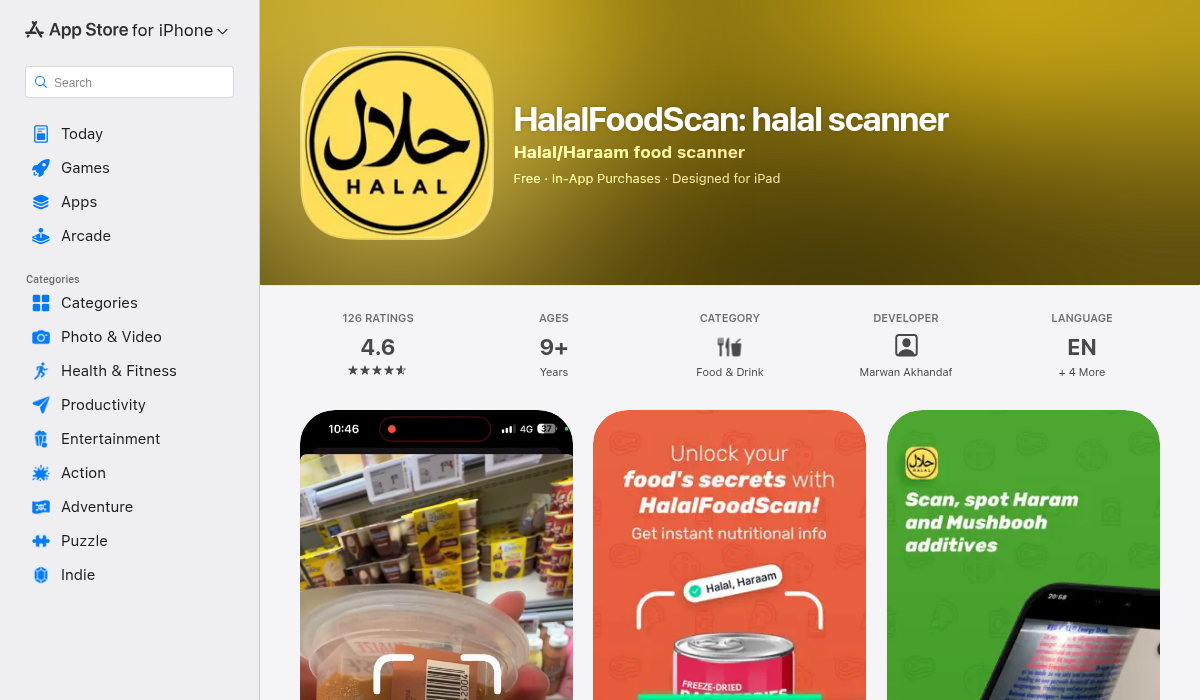
HalalFoodScan takes the guesswork out of grocery shopping. Just scan a product's barcode and get an instant Halal, Haram, or Mushbooh (doubtful) classification. The app works with millions of products and breaks down every ingredient and additive so you know exactly what you're eating.
What makes it particularly useful for the gelatin question:
- ✅ Barcode scanning — Instant halal/haram status for millions of products
- ✅ Additive detection — Identifies E-numbers like E441 (gelatin) and flags the source
- ✅ AI ingredient analysis — For products not in the database, scan the back of the package and the AI analyzes every ingredient
- ✅ Vinegar detection — Specifically addresses the common question about vinegar and alcohol
- ✅ No data collected — Fully privacy-focused
Instead of spending 15 minutes Googling whether the gelatin in your yogurt is pork or beef-derived, a 2-second scan gives you the answer.
Common Products That Contain Gelatin
You might be surprised how many everyday products contain gelatin. Here are the usual suspects:
- Gummy candies — Haribo, gummy bears, gummy worms (many use pork gelatin)
- Marshmallows — Almost always contain pork gelatin
- Yogurt — Some brands use gelatin as a thickener
- Medication capsules — Many soft gel capsules are made from gelatin
- Jell-O and similar desserts — Pork gelatin is the standard
- Some ice creams — Used as a stabilizer
- Frosted cereals — The frosting may contain gelatin
- Some cheeses — Used in processing
This is why having a scanner app is so valuable — gelatin hides in products you'd never expect.
The Bottom Line
Gelatin itself isn't inherently haram — it depends entirely on the source. Fish gelatin and plant-based alternatives like agar-agar are always halal. Bovine gelatin is halal only from properly slaughtered animals. Pork gelatin is considered haram by the vast majority of scholars, with only a minority accepting the istihalah (transformation) argument.
The safest approach? Stick to products that are halal-certified, choose plant-based alternatives when possible, and use tools like HalalFoodScan to quickly verify products when you're unsure.
Note: For specific religious rulings (fatwa), always consult with qualified Islamic scholars or your local imam. This article provides general information based on recognized Islamic sources and scholarly opinions.