
Measuring Pupillary Distance at Home: Complete Guide
You finally found the perfect glasses online at half the price of your optometrist's selection — but now you need your pupillary distance and no one will give it to you. Sound familiar?
Pupillary distance (PD) is the measurement between the centers of your pupils, and it's absolutely essential for getting glasses that actually work. Without an accurate PD, your lenses won't align with your eyes properly, leading to eye strain, headaches, and blurry vision — even with the correct prescription.
The frustrating part? Many optometrists won't include PD in your prescription, forcing you to either pay for another visit or figure it out yourself. This guide covers every method for measuring PD at home, from rulers to smartphone apps, so you can order those online glasses with confidence.
Why Pupillary Distance Matters So Much
Your PD ensures the optical center of each lens lines up precisely with your pupils. When this alignment is off, several things happen:
- Eye strain — Your eyes constantly work to compensate for misaligned lenses
- Headaches — Especially when reading or using screens for extended periods
- Blurry vision — Even with the right prescription, wrong PD = wrong results
- Depth perception issues — Critical for progressive lenses
For single vision glasses, a millimeter or two off might be tolerable. But for progressives or high prescriptions, accuracy becomes critical. The standard adult PD ranges from 54mm to 74mm, with most people falling between 58mm and 68mm.
"I used a website's DIY pupillary distance tool (a selfie of myself holding a ruler printed on paper right above my eyes) and it gave me a reading of 61mm. Then I went to my optometrist and one of the people there took my reading with a proper measuring tool (forehead in brace, eyes on the green dot). I got exactly the same result."— Reddit user in r/glassesadvice
The good news? You can absolutely measure your PD accurately at home. The key is using the right method.
Method 1: The Ruler Method (Classic But Tricky)
This is the old-school approach that online retailers often recommend. Here's how to do it properly:
- Stand 8 inches from a mirror in good lighting
- Hold a millimeter ruler against your brow, flat against your face
- Close your right eye and align the ruler's zero mark with the center of your left pupil
- Without moving the ruler, close your left eye and open your right
- Read the measurement at the center of your right pupil
- Repeat 3-5 times and take the average
Common Mistakes to Avoid
- Moving the ruler — This is the biggest source of error
- Using inches instead of millimeters — PD is always in mm
- Looking at the ruler — You should look straight ahead at the mirror
- Only measuring once — Always take multiple readings
"The technique involves closing one eye, aligning the zero mark with the centre of the other eye's pupil, then closing said eye and, without moving, re-opening the first and reading the figure."— Reddit user in r/optician
The Friend Method
Having someone else measure for you is actually more accurate:
- Face your friend at arm's length
- Look at something distant behind them (not at them)
- Have them place the ruler on your brow
- They measure from pupil center to pupil center
- Both eyes stay open — no switching required
The "look at something distant" part is crucial. Your pupils converge (move closer together) when focusing on nearby objects, which would give you a falsely lower PD for distance glasses.
Method 2: The Credit Card Method
Some online retailers provide printable rulers or use a credit card as reference (standard cards are 85.6mm wide):
- Print the retailer's PD ruler at 100% scale
- Verify accuracy by placing a credit card on the printout
- Hold the ruler to your face and take a selfie looking at the camera
- Measure on the photo from pupil to pupil
This method works but introduces variables — printer scaling, camera distance, and ensuring you're looking exactly at the lens.
Method 3: Smartphone Apps (Most Convenient)
Modern smartphone apps use AR (augmented reality) and face-mapping technology to measure PD with surprising accuracy. This is increasingly the preferred method for home measurement.
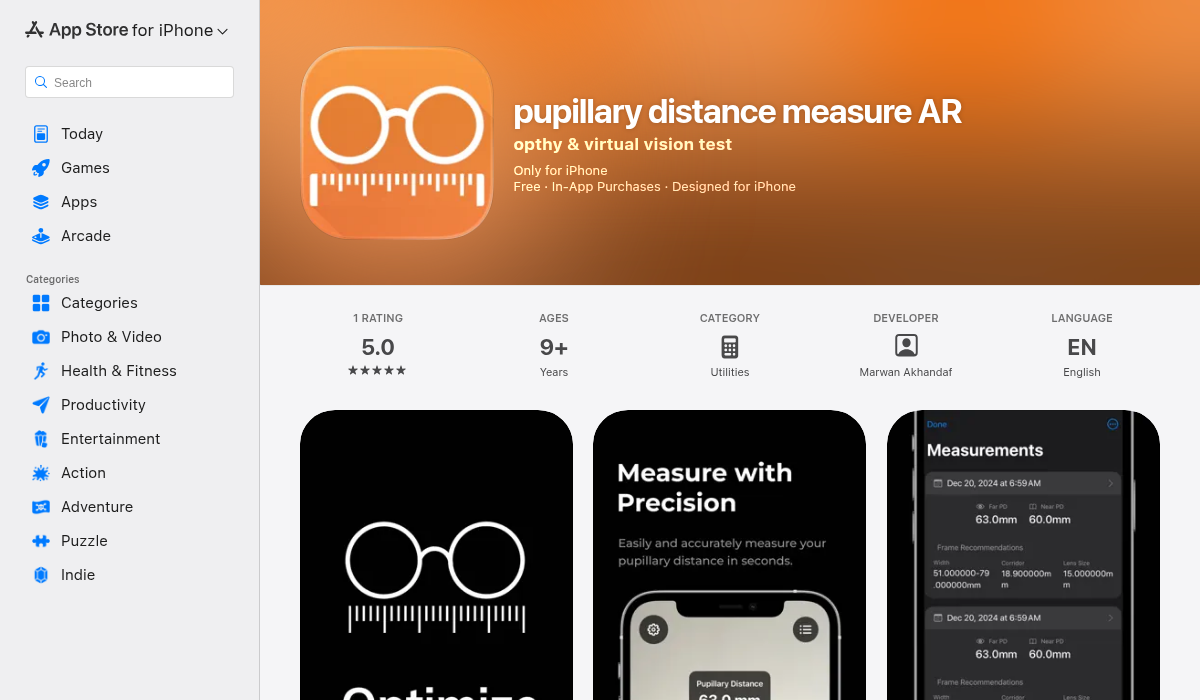
PD Measure AR uses your iPhone's TrueDepth camera system to map your face and measure pupillary distance with professional-grade accuracy. The AR approach solves the biggest problem with other methods — it accounts for vergence (how your eyes naturally converge when looking at nearby objects like rulers or screens).
Why AR-Based Measurement Works Better
- ✅ Accounts for vergence — Adjusts for eye convergence when looking at the screen
- ✅ No ruler required — Uses face geometry and camera calibration
- ✅ Measurement history — Track readings over time for consistency
- ✅ Single PD and dual PD — Measures both total and per-eye distances
"Accuracy is independent of measuring distance as long as your face is within camera range. Eyeballs sit on blobs of fat so positions constantly change (by a tiny bit like +/- 1 mm)."— Reddit user in r/berkeley
Most people have slightly asymmetrical faces, meaning the distance from nose to left pupil differs from nose to right pupil. Good PD apps like PD Measure AR give you both a "dual PD" (left and right measurements) and a combined "single PD" — useful depending on what your glasses retailer requires.
Single PD vs Dual PD — What's the Difference?
When ordering glasses online, you might see options for both:
- Single PD — Total distance between pupils (e.g., 64mm)
- Dual PD — Distance from each pupil to the center of your nose (e.g., 31mm / 33mm)
For most single vision glasses, a single PD is fine. For progressives, bifocals, or high prescriptions, dual PD provides better accuracy since it accounts for facial asymmetry.
Near PD vs Distance PD
Your eyes converge when looking at close objects, making your "near PD" about 3-4mm smaller than your "distance PD." This matters for:
- Reading glasses — Need near PD
- Computer glasses — Need intermediate PD
- Distance glasses — Need distance PD
- Progressives — Need distance PD (the lens design handles the near vision zones)
How to Know if Your PD Measurement is Accurate
Here's a sanity check for your measurements:
- Measure multiple times — Take 5+ readings and average them
- Use multiple methods — Try the ruler AND an app to compare
- Check the range — Adult PD typically falls between 54-74mm
- Watch for consistency — Readings should be within 1-2mm of each other
If your measurements vary wildly (more than 3mm difference between attempts), you're probably making technique errors. The most common issues:
- Not keeping your head perfectly still
- Looking at the ruler/camera instead of straight ahead
- Poor lighting making pupils hard to see
- Camera at wrong distance or angle
What If Your Optometrist Won't Give You Your PD?
This is frustratingly common. Many optometrists don't include PD on prescriptions because it's not technically part of the refraction — and honestly, because they want you to buy glasses from them.
Your options:
- Ask nicely — Some will measure it for free if you just ask
- Pay for measurement — Usually $10-25 for a standalone PD reading
- Measure at home — Using the methods in this guide
- Check old glasses — If you have glasses that work well, an optician can measure the lens centers
"How do I get my pupillary distance measured without buying glasses from an optometrist? Bit of a rant, bit of a question. I got an eye exam for $100 so I could buy glasses online, and they refused to give me my PD..."— Reddit user in r/Calgary
The home measurement route has gotten much more reliable. Apps using AR technology can match professional equipment accuracy for most people. If you're ordering expensive progressives or have a very high prescription, consider getting a professional measurement as a baseline — then you'll know your true PD for all future orders.
Pro Tips for Perfect PD Measurement
- Good lighting is essential — Natural light makes pupils easier to identify
- Stay consistent — Same distance from mirror/camera, same posture
- Look far, not close — For distance PD, focus on something 20+ feet away
- Average multiple readings — 5 measurements, drop the outliers, average the rest
- Compare methods — Use an app AND manual measurement to verify
The Bottom Line
Measuring your pupillary distance at home is absolutely doable with modern tools. While the classic ruler method works, smartphone apps with AR capabilities like PD Measure AR offer a more foolproof approach — they account for vergence automatically and give you a history of measurements to ensure consistency.
For single vision glasses from online retailers, a home measurement is perfectly adequate. For progressives or high prescriptions, consider using multiple methods and taking extra measurements to confirm accuracy.
The bottom line: don't let a missing PD stop you from ordering affordable glasses online. With the right technique — whether manual or app-based — you can get an accurate measurement in minutes and start saving money on eyewear immediately.