
Relieflog Migraine Tracker: What Actually Works
I've had exactly two migraines in my life. The first felt like someone was driving a nail through my left eye. The second came three weeks later, equally brutal, no obvious trigger. My doctor asked me to track them — what I ate, how I slept, the weather, stress levels. I opened a notes app and started typing, and it was a mess.
What I wanted was something that asked the right questions so I didn't have to remember everything in retrospect. What I found was Reliefog.
Why Migraine Tracking Is Different From Other Health Logging
Most health apps assume you know what you're tracking. You weigh yourself, log your steps, count your calories. With migraines, you're trying to discover patterns you can't feel in the moment — you're trying to find the trigger after the damage is done.
That means the app has to do the thinking for you. It has to ask the right questions at the right time, store the data in a way that's actually useful for a doctor, and not require a PhD in symptom logging to use.
What Reliefog Does
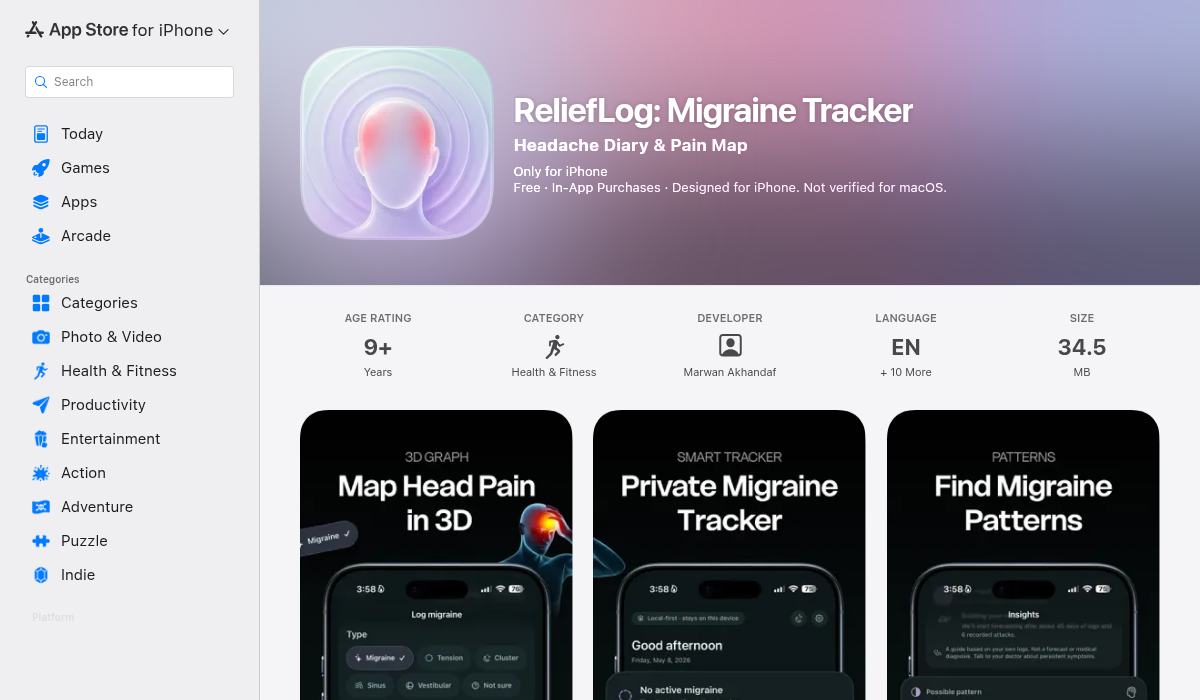
When a migraine hits, you open the app and start logging. Pain location (left temple, behind the eye, base of skull), pain type (throbbing, stabbing, pressure), intensity on a 1-10 scale. The app walks you through it step by step.
That's the core loop and it's solid. No thinking required — just answer the questions.
Trigger Identification
This is where it gets interesting. The app tracks common migraine triggers — weather changes, certain foods, sleep quality, stress, dehydration, hormones. Over time, it starts showing you patterns.
Mine showed a correlation with low pressure systems. I'd had no idea. I thought it was stress or sleep, which are easier to blame. But looking at the data, the weather pattern was stronger than any behavioral trigger. That's useful information I couldn't have figured out on my own.
Weather and UV Correlation
The app logs barometric pressure, humidity, and UV index at the time of each migraine. I was skeptical of this at first — it felt like overreach. But the pressure data was genuinely useful. Migraines triggered by weather changes are well-documented in the literature, and having the specific pressure reading for each logged migraine made the pattern obvious in a way that just "feeling off" never did.
Export for Doctor Visits
This is the feature that should be in every health app and almost never is. You can export a summary of your migraine history — frequency, average intensity, most common triggers, pain locations — in a format a doctor can actually read.
My neurologist loved it. She usually gets a vague verbal history ("I get them sometimes, maybe when I'm stressed"). Instead, I showed her a six-week log with pressure readings, trigger correlations, and intensity trends. She adjusted my treatment plan based on data she'd never had access to before.
What It Doesn't Do
It doesn't predict migraines. Some apps claim to use patterns to forecast an oncoming migraine, but Reliefog doesn't go there — and honestly, that's honest. The science on predictive migraine modeling isn't there yet, and an app claiming to predict them would be overstating the evidence.
It also doesn't integrate with Apple Health, which means you're not getting a holistic picture of sleep, activity, and nutrition alongside your migraine data. That's a gap if you want to correlate everything in one place.
How It Compares to Just Using Notes
I tried the notes approach for two months before finding Reliefog. It failed for one reason: inconsistency. Some days I'd remember to log. Other days I'd open Notes and type "bad headache today" and nothing else. The data was useless because I wasn't asking myself the right questions.
Reliefog forces consistency by making the logging process fast and structured. You answer five questions, you're done. That's the whole difference.
The Bottom Line
If you get migraines and you've ever thought "I should figure out what's causing these," Reliefog is the tool that actually lets you do that. The structured logging, trigger correlation, and doctor-ready export are exactly what you need — and none of it requires effort you don't have during a migraine.
It's not a treatment. It won't make the migraine stop. But it'll tell you patterns you'd never see on your own, and that information is worth something.
To try it: Reliefog – Migraine Tracker