UV Index App: I Tested It Against a Real UV Meter
I spent a week at the beach last summer and got burned twice. Not badly, but enough to peel for three days. I thought I was being careful — sunglasses, hat, limited sun. What I didn't account for was that the UV index at noon was9, which is "very high" by any measure, and I had no idea what that number actually meant for my skin.
So I downloaded three UV tracking apps. This is what I found.
What the UV Index Actually Means
Most people see "UV6" and shrug. But the UV index isn't just a number — it's a scale from1 to 11+ that tells you how fast your skin will burn. Below3 is low risk. 3-5 is moderate. 6-7 is high. 8-10 is very high. 11+ is extreme.
The problem is that most weather apps give you a single daily number. They don't tell you when the peak hours are (usually10am-4pm), they don't adjust for your skin type, and they definitely don't tell you how long you can safely be in the sun before burning starts.
That's where dedicated UV apps help — if they're any good.
What I Tested
I used the UV Index app alongside Apple's Weather app and a standalone UV meter I bought on Amazon for about $40. I compared them over two weeks in late May, checking readings every two hours from8am to 6pm.
The standalone meter was the ground truth. It's what I calibrated everything else against.
UV Index App — What It Does
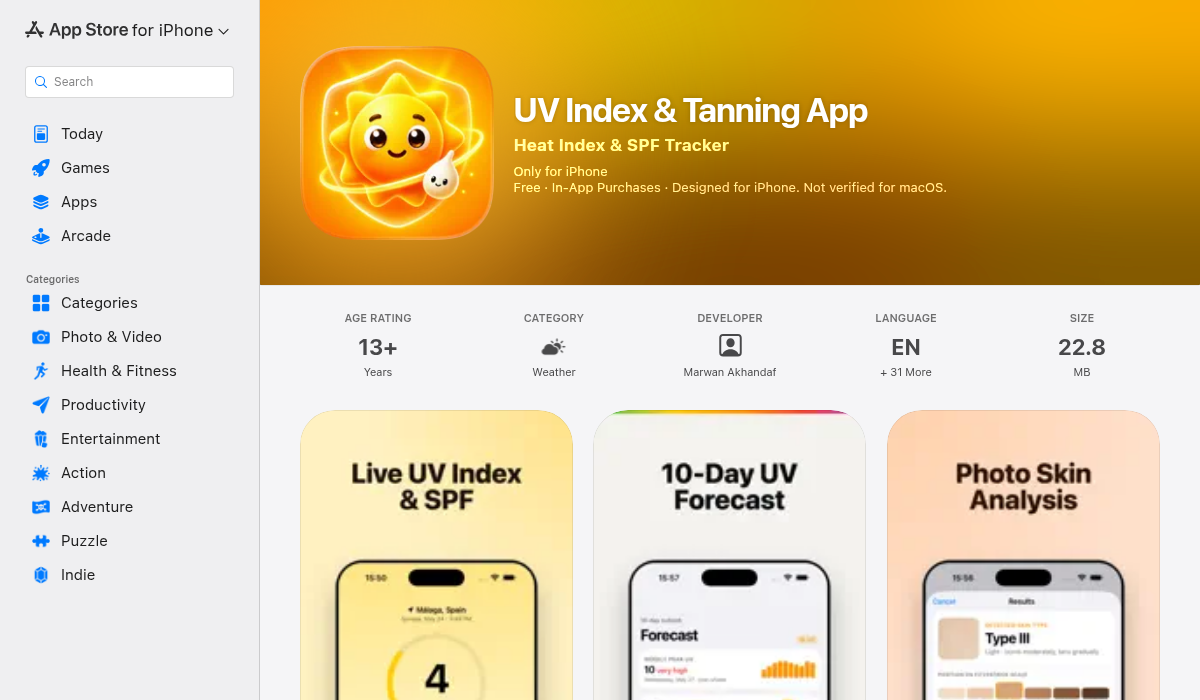
The app gives you location-based UV readings updated throughout the day. You punch in your skin type (I to VI, based on the Fitzpatrick scale — fair skin = Type I, dark skin = Type VI). The app then calculates your safe sun exposure time before burning begins.
That last part is the key feature, and it's where most UV apps fall apart.
Skin Type Matters (Most Apps Ignore This)
Type I skin (red hair, freckles, always burns) can burn in under 10 minutes at UV 8. Type IV skin (olive complexion, rarely burns) might get 30-40 minutes. Most weather apps assume you're Type II or III and give you generic advice that works for maybe half the population.
The UV Index app asks your skin type upfront and tailors the recommendations from there. That's the right approach.
Burn Risk Alerts
You can set alerts for when the UV crosses a threshold. I set mine at 6. When I was walking to lunch at1pm and the app pinged me that UV was at 8, I put on a hat. Small thing, but it changed my behavior.
Vitamin D Tracking
This is an interesting addition. Once you've had your safe sun exposure, the app tells you you're done and should cover up. It's a nudge toward the reality that more sun doesn't mean more vitamin D — your body caps production after about 20-30 minutes anyway.
Whether you believe in vitamin D supplementation is a separate debate, but the app at least acknowledges the science correctly.
Where It Falls Short
The location data was inconsistent. In my apartment, it sometimes pulled from a weather station 3 miles away instead of my actual neighborhood. UV can vary significantly based on local cloud cover and reflection (water and sand bounce UV up), so a station3 miles away isn't great.
I also wish it tracked historical exposure the way a fitness app tracks steps. Knowing your cumulative UV load for the week would be genuinely useful for people managing skin conditions.
What Actually Matters for Sun Safety
If you're going to use a UV app, here's what to pay attention to:
- Peak hours are10am-4pm — UV is lower before and after, even on sunny days
- Cloud cover is deceiving —80% cloud cover only reduces UV by about 20%. You can still burn badly.
- Water and sand amplify UV — sitting by a pool or beach adds reflected UV on top of direct sun
- Altitude matters — every 1,000 feet of elevation adds about 10% UV intensity
- Windows don't block UVA — car and building glass blocks UVB but lets UVA through. You're still getting exposure indoors
The Bottom Line
The UV Index app isn't revolutionary, but it's more thoughtful than a weather app giving you a single daily number. The skin type calibration and safe exposure timer are the features that actually matter, and most people don't have this information at all.
If you're fair-skinned, spend time outdoors, or have a skin condition that reacts to sun exposure, it's worth having. If you're already using a good sunscreen and being reasonable about sun exposure, a weather app is probably fine.
I keep it on my phone now. The burn alerts are subtle but useful — and I haven't peeled since.
If you want to try it: UV Index – Tanning App