
ZETA vs HalalFoodScan: Best Halal Scanner App Compared
Checking if your groceries are halal shouldn't feel like solving a chemistry puzzle. Yet here we are, squinting at tiny ingredient lists, googling E-numbers in supermarket aisles, and still unsure if that candy bar is safe to eat.
The good news? In 2026, there are more halal scanner apps than ever. The challenging part? Choosing which one actually works. Two apps that keep coming up in conversations are ZETA — a web-based scanner that covers halal, vegan, and kosher — and HalalFoodScan — a dedicated iOS app focused exclusively on halal verification.
We tested both extensively. Here's an honest comparison to help you decide which one belongs on your phone.
The Real Struggle with Halal Shopping
If you've ever spent ten minutes in a grocery store trying to figure out whether "natural flavors" or "E471" are halal, you know the pain. Ingredient labels are deliberately vague. Additives have cryptic names. And unless you have a chemistry degree, decoding what's actually in your food feels impossible.
"I have this app called TagHalal Food but I have noticed inconsistent results. When I scan the barcode, it gives me Halal result, but I scan the ingredients, it gives me Haram result for the same product."— Reddit user in r/islam
This is the core problem: inconsistency. Many halal apps rely solely on barcode databases that may be outdated, incomplete, or simply wrong. When the barcode doesn't work, you're back to square one — staring at ingredient labels with no answers.
The best apps solve this by combining multiple detection methods: barcode scanning and ingredient analysis and additive databases. Let's see how ZETA and HalalFoodScan stack up.
ZETA: The Multi-Purpose Web Scanner
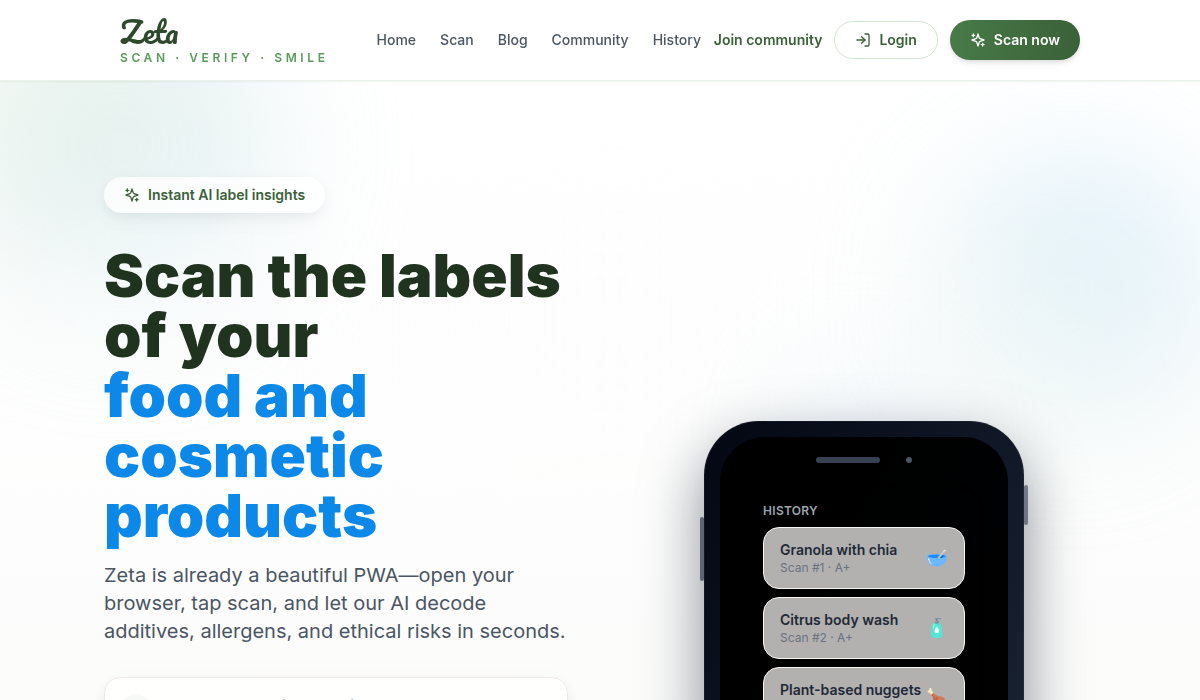
ZETA positions itself as an all-in-one dietary scanner. It's a Progressive Web App (PWA), meaning you use it through your phone's browser rather than downloading from the App Store. This approach has both advantages and drawbacks.
What ZETA Does Well
- ✅ Multi-diet support — Covers halal, kosher, and vegan in one app
- ✅ Massive database — Claims 4+ million food products and 2+ million cosmetics
- ✅ Works on any device — Being web-based means it runs on Android, iOS, and desktop
- ✅ Privacy-focused — Scans stay on your device unless you sync
- ✅ Cosmetics coverage — Also scans beauty products for halal compliance
Where ZETA Falls Short
- ❌ No native app — PWAs can feel clunky compared to real apps
- ❌ Premium required for offline — Can't scan without internet unless you pay
- ❌ Jack of all trades — Trying to cover halal, vegan, and kosher may dilute focus
- ❌ Limited ingredient scanning — Primarily barcode-based
ZETA works best for users who need one app that handles multiple dietary restrictions — for example, a household where one person is vegan and another keeps halal. The web-based approach is clever but feels less polished than a dedicated native app.
HalalFoodScan: Dedicated Halal Focus
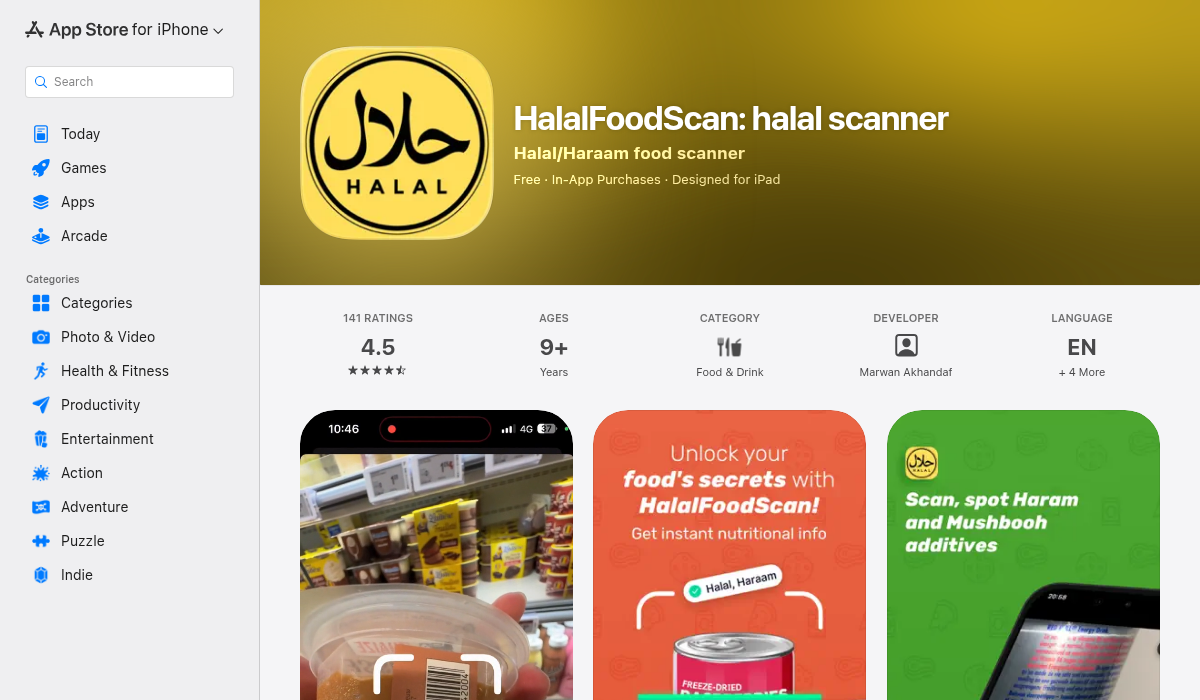
HalalFoodScan takes the opposite approach: it does one thing and does it well. This iOS-native app focuses exclusively on halal verification, with features designed specifically for Muslim users.
What HalalFoodScan Does Well
- ✅ Dual scanning — Barcode scanning AND ingredient label scanning
- ✅ Additive analysis — When barcode fails, scan the ingredients list for AI analysis
- ✅ Clear categories — Halal (حلال), Mushbooh (مشبوه), Haram (حرام), Unknown
- ✅ Native iOS experience — Fast, smooth, designed for iPhone/iPad
- ✅ Privacy-first — No data collected according to App Store privacy label
- ✅ Vinegar detection — Special feature addressing common vinegar questions
- ✅ Multiple languages — English, Arabic, Dutch, French, Spanish
Where HalalFoodScan Could Improve
- ❌ iOS only — No Android version yet
- ❌ No cosmetics — Food products only
- ❌ Limited free scans — Full access requires subscription
The killer feature here is ingredient label scanning. When a product isn't in the barcode database — which happens often with regional or new products — you can photograph the ingredients list and get AI-powered additive analysis. This solves the biggest pain point with halal apps.
Head-to-Head Comparison
Here's how the two apps compare on key features:
Platform:
• ZETA: Web (PWA) — works everywhere
• HalalFoodScan: iOS native — iPhone, iPad, Mac, Vision Pro
Focus:
• ZETA: Multi-diet (halal, kosher, vegan)
• HalalFoodScan: Halal-only (deeper focus)
Barcode scanning:
• ZETA: ✅ Yes
• HalalFoodScan: ✅ Yes
Ingredient scanning:
• ZETA: ❌ Limited
• HalalFoodScan: ✅ AI-powered additive detection
Cosmetics:
• ZETA: ✅ Yes
• HalalFoodScan: ❌ Food only
Offline mode:
• ZETA: Premium only
• HalalFoodScan: Core features work offline
Privacy:
• ZETA: Strong (local-first)
• HalalFoodScan: Excellent (no data collected)
Price:
• ZETA: Free with Premium upgrades
• HalalFoodScan: Free with limited scans, $1.99/month or $39.99 lifetime
A Note on Islamic Guidance
It's worth understanding why these apps categorize ingredients as they do. The Quran provides clear guidance on what is forbidden:
"He has only forbidden to you dead animals, blood, the flesh of swine, and that which has been dedicated to other than Allah."— Quran 2:173 (Surah Al-Baqarah)
For additives, the complexity arises because many can be derived from either plant or animal sources. E471 (mono and diglycerides), for example, is halal when plant-derived but questionable when animal-derived. This is why these apps categorize such additives as Mushbooh (مشبوه) — meaning "doubtful" or "questionable."
The Prophet ﷺ taught us to avoid doubtful matters:
"What is lawful is clear and what is unlawful is clear, and between them are doubtful matters which many people do not know. He who guards against doubtful things keeps his religion and honor blameless."— Prophet Muhammad ﷺ (Sahih Bukhari 2051)
Both ZETA and HalalFoodScan help you identify these doubtful ingredients so you can make informed decisions. HalalFoodScan's three-tier classification (Halal/Mushbooh/Haram) directly reflects this Islamic framework.
Note: For specific religious rulings (fatwa), always consult with qualified Islamic scholars or your local imam. These apps provide guidance based on recognized Islamic sources but cannot replace scholarly advice.
Which App Should You Use?
After testing both, here's our recommendation:
Choose ZETA if:
- You need halal AND vegan/kosher scanning in one app
- You use Android (no HalalFoodScan option)
- You want to scan cosmetics and beauty products
- You prefer web-based tools over app downloads
Choose HalalFoodScan if:
- You have an iPhone/iPad and want the best native experience
- You frequently encounter products not in barcode databases
- You want dedicated halal focus without extra features
- Ingredient label scanning is important to you
- You prefer apps that collect zero personal data
For most Muslim users with iPhones, HalalFoodScan offers the better experience. The ingredient scanning feature alone solves the biggest frustration with halal apps — those moments when the barcode doesn't work and you're stuck guessing. The clear Halal/Mushbooh/Haram categories align with Islamic principles, and the native app performance feels significantly smoother than a web-based solution.
That said, ZETA deserves credit for its multi-diet approach. If your household includes vegans or you want cosmetics coverage, it's a solid choice — especially on Android where HalalFoodScan isn't available.
Pro Tips for Better Halal Shopping
- Use both scanning methods — Start with barcode, fall back to ingredient scanning when needed
- When in doubt, check Mushbooh items — Contact the manufacturer about specific additive sources
- Look for certification logos — JAKIM, MUI, IFANCA, and other recognized bodies
- Build a personal product list — Once you verify a product, save it for quick reference
- Keep apps updated — Databases expand constantly with new products
The Bottom Line
Both ZETA and HalalFoodScan represent how far halal scanning technology has come. Gone are the days of memorizing E-number lists or avoiding entire product categories out of uncertainty.
For dedicated halal verification on iPhone, HalalFoodScan offers the most focused, reliable experience. Its ingredient scanning feature fills the gap that most halal apps leave open, and the privacy-first approach means you're not trading your data for convenience.
For multi-diet households or Android users, ZETA provides a capable all-in-one solution through your browser.
Whichever you choose, having a reliable halal scanner on your phone transforms grocery shopping from stressful guesswork into confident decisions. And that peace of mind? Worth every penny.